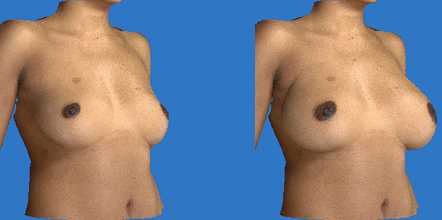
From the "PIP affair" to the recent "Implant Files," the breast implants used in cosmetic, plastic or reconstructive surgery procedures have received particular attention from health authorities, the scientific community and the media. This article reviews the implants used by Dr Kron in the plastic surgery procedures he performs and presents the advantages of Motiva implants, used in the vast majority of the breast augmentations he performs.
Update of 06/10/2022:
The American laboratory Establishment Labs now offers the second generation of the Motiva range: Ergonomix2® implants. These implants are the culmination of research carried out over several years in the field of breast implants. Ergonomix2® implants provide an even more natural result and greater safety for patients.
Implants that have proven their efficacy and safety
Since he began practicing as a cosmetic surgeon, Dr Cédric Kron has always selected breast implants that have proven their efficacy and safety. As the field of implants is the subject of constant scientific advances, the type of implants used by Dr Cédric Kron has evolved over the years.
Since the start of his private practice, Dr Kron has used both round and anatomical implants.
Anatomical implants
For anatomical implants, it was necessary to minimize the risk of rotation as much as possible. Scientific recommendations at the time favored macro-textured anatomical implants, notably from the Allergan brand.
From 2011, Dr Kron used anatomical polyurethane breast implants. This type of implant long remained the best option in terms of result and safety. Numerous scientific studies have shown that this type of implant drastically reduces the risk of capsular contracture ("hardening"), displacement or rotation of the implant, which is essential for anatomical implants.
Scientific publications and Dr Kron's personal experience led him to decide to only place polyurethane implants when it comes to anatomical implants.
Polyurethane breast implants
Dr Kron used polyurethane breast implants from the Silimed and Polytech laboratories. The main aesthetic drawback of anatomical implants is that they are somewhat "rigid."
For nearly 3 years, Dr Kron has used almost exclusively implants from the Motiva brand. These are latest-generation implants that offer numerous advantages in terms of safety, result and traceability. In a few very specific cases, such as breast reconstruction or a complex recurrence after capsular contracture, he uses polyurethane implants, which offer certain specific advantages (which will be explained during a consultation).
Motiva ERGONOMIX® implants:
In the vast majority of the breast augmentations he performs, Dr Kron uses implants from the Motiva ERGONOMIX® range offered by the American laboratory Establishment Labs. This laboratory benefits from the expertise of a scientific committee made up of internationally renowned experts in the field of breast implants and cosmetic, plastic and reconstructive surgery, most of whom Dr Kron knows well.
Based on our current knowledge, MOTIVA implants are the breast implants that offer the best ratio of fill rate – deformability – elasticity. They therefore provide a significant, as natural as possible result, while offering a high degree of safety. This deformability makes the implant "anatomizable" according to gravity in a way that, in Dr Kron's experience, surpasses other brands he is familiar with.
These latest-generation implants therefore offer the following advantages:
- An international scientific committee of world-renowned plastic surgeons specializing in breast augmentation,
- nanotexturing of the implant surface: even finer and more regular than microtexturing, avoiding the risks of both macro-textured and smooth implants,
- Ergonomix® technology enabling a more natural result and easier traceability.
- Qid® technology enabling easier traceability.
Minimizing the risk of inflammation with nanotexturing
Motiva implants offer a much finer texturing (nanotexturing) than implants of the previous generation (microtexturing). Using nanotechnologies, these implants also offer greater texture regularity.
Similarly, but with even greater effectiveness than microtextured implants, Motiva implant nanotexturing helps limit the risk of implant displacement or rotation, as well as the risk of capsular contracture ("hardening").
Furthermore, this nanotexturing significantly further limits the (particularly exceptional) risks of chronic inflammation that could lead to Breast Implant-Associated Anaplastic Large Cell Lymphoma (BIA-ALCL).
Are these textured implants?
Under the ISO classification (International Organization for Standardization) for breast implants, the surface topography of the Motiva SmoothSilk® (also known as SilkSurface®) implant shell is classified in the smooth implant category given its low roughness (average roughness below 10 μm).
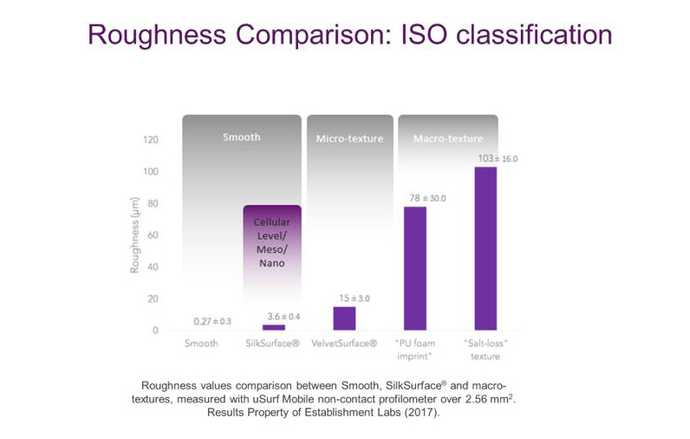
> Learn more about ISO 14607 standard (Non-active surgical implants – Mammary implants)
A result as natural as possible
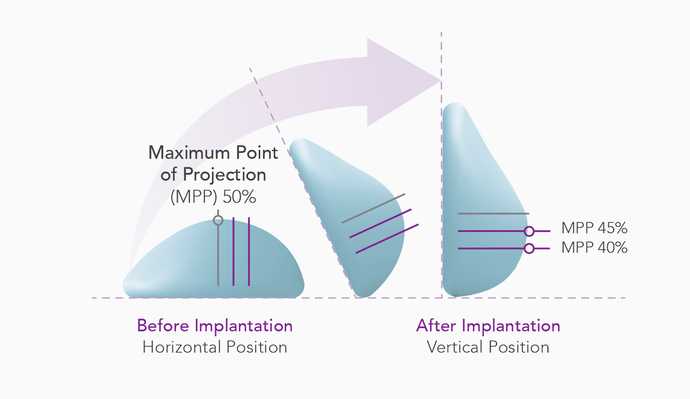
The Motiva ErgonomixTM range used by Dr Kron features patented TrueTissueTM technology. This allows the implant's shape to evolve according to body posture and gravity, offering as natural a result as possible in all circumstances.
When the patient is lying on her back, the implant takes on a round shape, the same way a natural breast would in this position. When the patient is standing, the implant takes on a more anatomical, teardrop shape, just as breasts naturally would.
Easier traceability with Q Inside technology
The "Implant Files" revealed gaps in implant traceability on the part of some practitioners or clinics. Some patients sometimes find it difficult to know the exact references of their implants.
Dr Kron's patients have always been given the references of their implants, provided during their first follow-up consultation, and which remain available to them whenever they wish.
Q Inside technology makes it possible to precisely identify all the characteristics and references of the implant in a non-invasive way (i.e. without any incision).
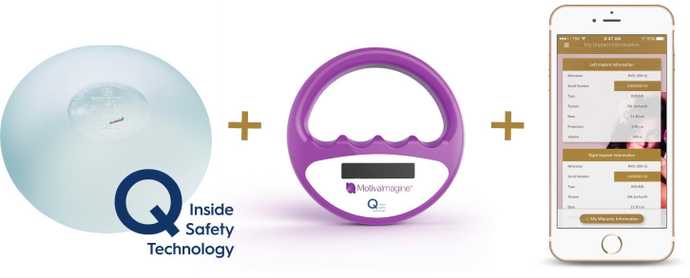
Each implant in the Motiva range contains a passive radio-frequency identification transponder (RFID) that allows any healthcare professional equipped with the appropriate device to remotely read the implant's information. This "passive" device (meaning it does not emit a signal but can respond to a signal sent to it) is safe. This technology has been approved by the American authorities (FDA) as well as CE marked in Europe.
This technology provides an additional safeguard for patients in the event of a claim or if they misplace information relating to the implant and its warranty.
Learn more:
> Presentation of Motiva implants (French)
> Learn more about the Motiva Ergonomix2® range
> News: Ergonomix2® Implants: An even more natural result with increased safety