
The terms "flush", "erythrosis", "rosacea" and "couperose" describe different stages of the same chronic inflammatory disease of the facial blood vessels. To reduce or even remove the redness caused by the dilation of facial blood vessels, two treatments appear particularly effective: the Universkin medical cosmetic protocol and the Icon Max G laser treatment.
What is the difference between flushing, rosacea and erythrosis?
When talking about flush, erythrosis or rosacea, these refer to different stages of the same chronic inflammatory disease of the skin's blood vessels. The generic term rosacea corresponds to a vasodilation phenomenon, meaning the dilation of the blood vessels located just beneath the skin.
This redness is not always painful and is never serious. However, it is unsightly and can cause social discomfort. The condition can progress from one stage to another over time, but this progression is unpredictable and does not affect every patient.
"Flushes": transient redness
The first stage corresponds to transient redness. It appears on the nose, cheekbones or forehead. It may be accompanied by tingling and a slight burning sensation.
This redness generally disappears after a few minutes. This is sometimes referred to as "hot flashes", which can cause social discomfort.
Erythrosis: permanent diffuse redness
Erythrosis refers to facial skin redness that is permanently visible but remains diffuse (the vessels themselves are not distinguishable). The cheekbones and cheeks are the areas most affected by erythrosis.
Couperose: blood vessels visible to the naked eye
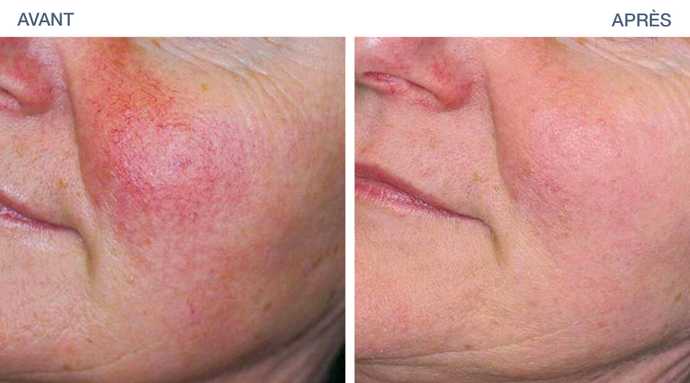
When the dilated vessels are visible to the naked eye, this is referred to as couperose. This is the stage that follows erythrosis.
Couperose is generally most visible on the cheekbones, the sides of the nose and the chin. Couperose is generally considered very unsightly. It can cause self-consciousness and social discomfort for the patient.
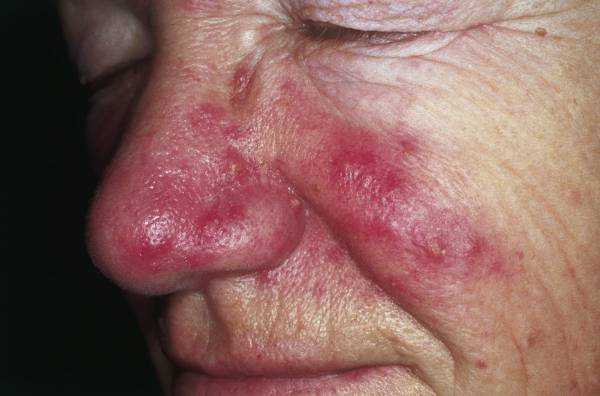
Papulopustular stage of rosacea
The papulopustular stage is considered the most advanced stage of rosacea. The redness appears in the form of skin lesions (red bumps, pustules, papules).
Rosacea is more uncomfortable than erythrosis or couperose, because the sensations of heat or burning are more pronounced.
In the most advanced cases, the lesions take the form of swellings on the nose (rhinophyma), chin and cheeks. These hypertrophic forms of rosacea mainly affect men after age 50.
Causes of rosacea and erythrosis
Poorly understood causes
The physiological explanation for the appearance of rosacea and erythrosis is not well understood. The origin of this facial redness is considered to be multifactorial. The main causes include:
- Genetic inheritance (people with fair skin and light eyes are more likely to be affected by rosacea and erythrosis).
- The excessive presence of a skin mite called demodex folliculorum,
- A physiological dysfunction causing hyper-reactivity of the facial skin's blood vessels.
- Skin aging, which makes the skin thinner and more sensitive and tends to worsen rosacea.
Aggravating factors for rosacea and erythrosis:
- Alcohol, as it promotes vasodilation, making rosacea more visible.
- Prolonged sun exposure without protection.
- Spicy food and coffee consumption.
- Cold temperatures (rosacea tends to appear more during winter months).
- Sudden changes in temperature (very hot showers or baths).
- Intense emotions (anger, stress, anxiety), which can trigger facial redness. This is sometimes referred to as "blushing erythema".
- Certain medications such as corticosteroids and antihypertensive drugs.
Who is affected by rosacea?
Facial redness such as erythrosis, rosacea and couperose particularly affects people with fair skin, hair and eyes. The first signs of rosacea can appear from age 25, but it peaks between 40 and 50.
The early stages of this redness affect women more often than men, particularly between 40 and 50 years old. This redness appears particularly on the cheekbones, cheeks and sides of the nose.
On the other hand, the most advanced forms of rosacea affect men more, after age 50. This is the papulopustular stage of rosacea, where redness is accompanied by swelling on the nose, chin or forehead.
Rosacea can be accompanied by ocular rosacea, whose symptoms are similar to conjunctivitis. In case of eye involvement, it is important to consult an ophthalmologist. Indeed, ocular rosacea can lead to blepharitis (inflammation of the eyelids) or keratitis (inflammation of the cornea).
Cosmetic treatments for rosacea
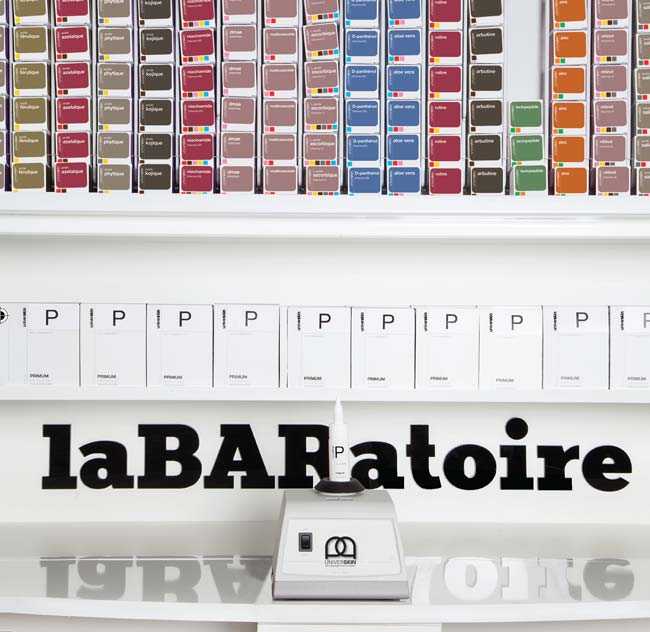
In the less advanced forms of the condition (flush, erythrosis and, to some extent, couperose), a cosmetic treatment can reduce redness.
Creams rich in vitamin C (which strengthens the walls of sensitive vessels) and vitamin B3 (which strengthens the skin and defends it against external aggressions) are indicated.
Dr. Kron's practice offers the Universkin functional dermatology protocol to create custom cosmetic prescriptions for patients. The Universkin protocol is indicated for treating the causes and consequences of erythrosis, couperose and rosacea.
For an optimal result, it is important to adopt a skincare routine that avoids fragranced products or those containing alcohol, as these can dry out the skin. An appropriate lifestyle is also recommended. Avoid spicy foods, alcohol consumption, temperature contrasts, or prolonged sun exposure.
For more advanced forms of the condition, these cosmetic treatments can also be combined with topical antibiotic treatment (in cream form) targeting the excessive presence of the mite demodex folliculorum.
Laser treatment for rosacea
Laser is the gold-standard treatment for treating skin redness. For treating rosacea or couperose, it is more effective than a peel.
For the least advanced stages of the condition (flush, erythrosis), laser achieves a more significant result than a purely cosmetic treatment.
Laser is also indicated for treating more advanced forms of the condition, such as rosacea and skin lesions. Indeed, the laser can target facial vascular lesions: the "small vessels" that appear under the facial skin, notably on the nose (nostrils), cheeks and chin.
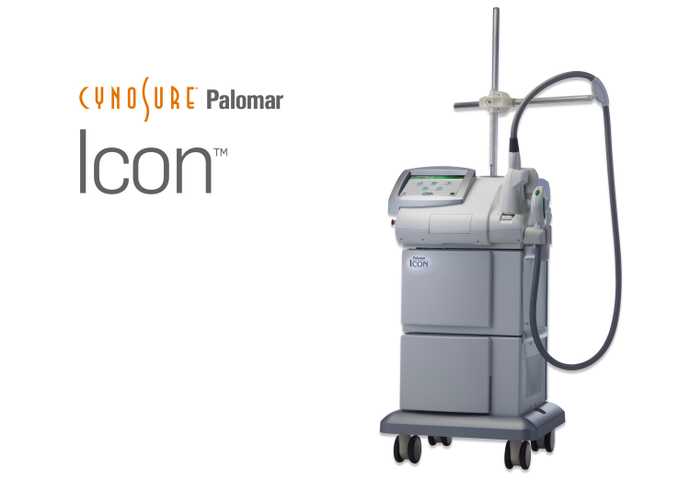
Icon Max G laser
Not all lasers used in aesthetic skin medicine treatments are equally effective on cutaneous vascular lesions. Dr. Kron's practice is equipped with the Icon Max G laser, which is particularly effective for correcting rosacea, couperose and erythrosis.
Designed by the American laboratory Cynosure, the Icon Max G laser uses an exclusive technology based on Optimized Pulsed Light (OPL). This technology very effectively treats facial spider veins thanks to two overlaid filters that allow for more precise absorption of the delivered energy by vascular targets.
Thanks to its dual emission spectrum (500-670 nm and 870-1200 nm), the Icon laser is particularly effective for treating facial vascular lesions.
> Learn more about the Icon Max G laser
What happens during a session
Recovery after an Icon Max G laser session is generally simple. It has no direct action on the outer layer of the skin, which avoids social downtime following the procedure. Indeed, it does not cause any "crust" or disfiguring skin lesion.
Slight redness may appear within 48-72 hours after the session. Recovery is not painful, even though a sensation similar to a sunburn may be felt. Within about ten days after the procedure, slight peeling of the epidermis may occur.
Laser results on rosacea
The result of a laser treatment for rosacea is not visible immediately at the end of the session. It is necessary to wait for the skin to regenerate following the laser's action.
The number of sessions needed to achieve an optimal result depends on the patient's tissue characteristics and the stage of the rosacea. Results start to become visible after a single laser session. However, it is recommended to have at least two or three sessions to treat vascular lesions at several depth levels. One session will treat superficial lesions, another the deeper ones, for example.
To enhance the results of laser treatment for rosacea, it is advisable to combine laser sessions with custom cosmetic prescriptions such as the Universkin protocol.
Face diagnostic consultation
To support you in your aesthetic medical facial treatments, Dr. Kron and his team have set up a face diagnostic pre-consultation. Based on the use of scientific tools to analyze the condition of your skin, the goal of this diagnostic is to inform you about the possible treatments based on your expectations.
This consultation determines which type of cosmetic and/or medical and/or surgical treatment is best suited to meet your expectations. In the case of facial redness such as rosacea or erythrosis, this consultation is particularly indicated to offer you a tailored treatment protocol that combines the Universkin medical cosmetic protocol with Icon Max G laser sessions.
> Learn more about the face diagnostic consultation
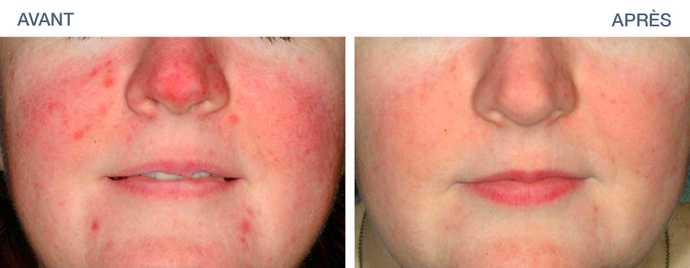
Before-After
Result of the Universkin protocol on facial redness
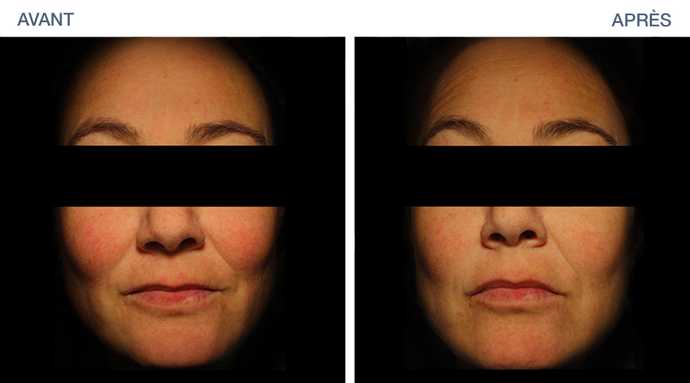
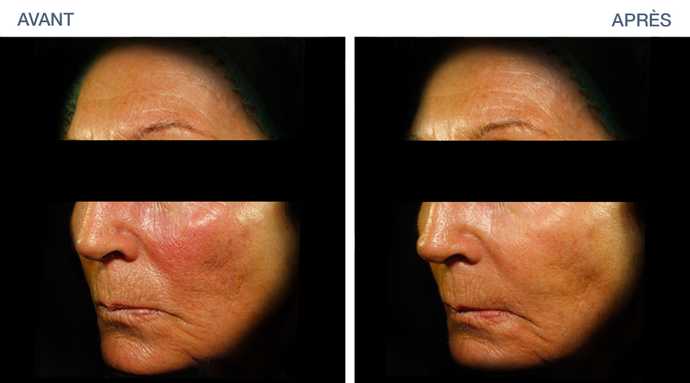
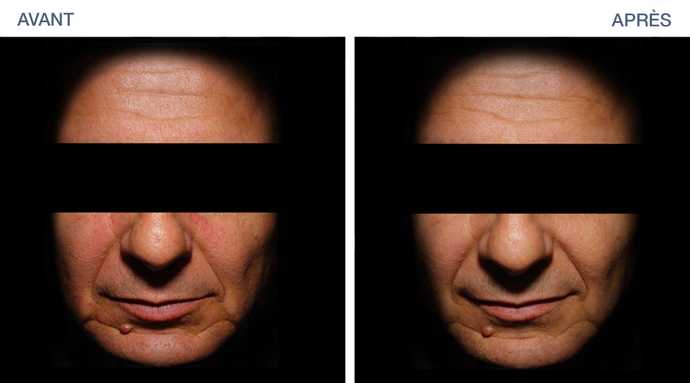
Photographs provided by the Universkin laboratory.
Results of laser treatments for rosacea
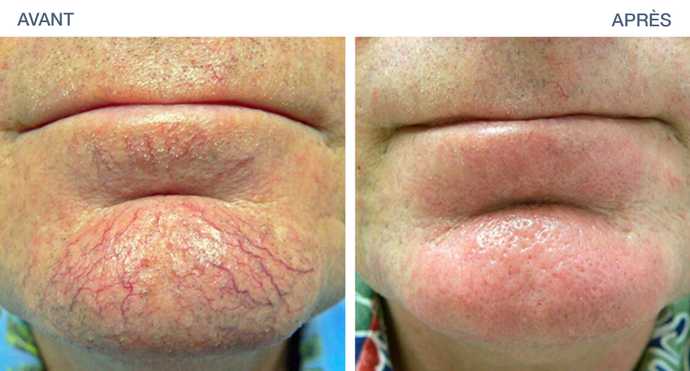
Photographs provided by the Cynosure laboratory.
