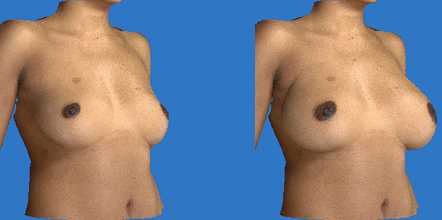
Breast augmentation is a proven cosmetic surgery procedure that provides a natural, long-lasting result. While complications are rare, the risk of capsular contracture is always present. To limit the risk of "hardening" or implant rotation, Dr Kron uses polyurethane breast implants.
What is capsular contracture?
When a breast implant is placed during breast surgery, the body reacts by forming a shell around the implant. This is a natural response of the body to a "foreign" implant. This shell, formed by the body's fibrous tissue, is called a "capsule," "capsular tissue" or "fibrous capsule."
In most cases, this capsule remains thin and has no effect on the aesthetic result of the procedure: the breasts remain "naturally" soft and the bust harmonious. More rarely, the capsule contracts, thickens and hardens. The breasts then become too firm and may appear misshapen. This phenomenon is known as capsular contracture, or "hardening." It can sometimes be addressed with anti-inflammatory treatments or through revision surgery. In rarer cases, implant removal may be necessary.
Reduced risks thanks to polyurethane implants
Studies conducted over more than 20 years have shown that the risk of complications related to capsule formation is drastically reduced by the use of polyurethane breast implants.
The polyurethane foam surrounding the implant allows for an active healing process. Instead of a single capsule forming, which carries a significant potential for contraction, the polyurethane foam promotes the formation of numerous micro-encapsulations within the foam, which neutralizes the risk of contraction.
By allowing better tissue adhesion, these implants significantly reduce the risk of implant displacement or rotation following the procedure. Tissue adhesion is substantial, and in Dr Cédric Kron's experience, this has allowed him to eliminate the risk of implant rotation, a concern typically associated with anatomical implants.
Dr Kron also serves as an Expert at training sessions for university hospital surgeons and speaks at conferences on the subject of breast augmentation with anatomical polyurethane implants.
Dr Kron uses polyurethane breast implants from two laboratories recognized in the field: Silimed and Polytech.