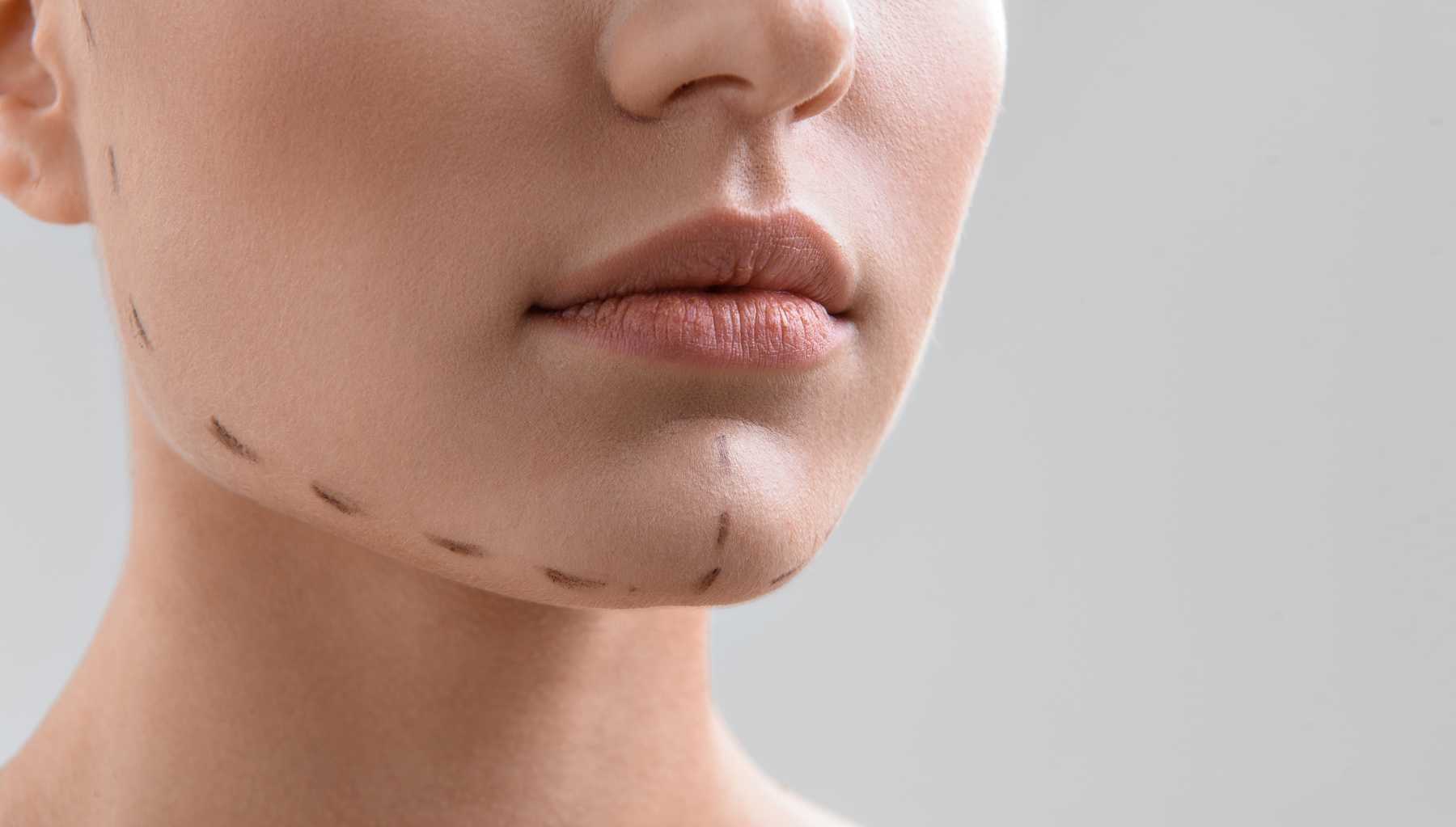
The chin is one of the most important elements of facial harmony, just like the nose, eyes or cheeks. By correcting an unbalanced chin, genioplasty (cosmetic chin surgery) restores facial harmony and rebalances the profile.
1. Principle of a genioplasty
Generally, a chin is considered to have a harmonious shape when a vertical line drawn from the most prominent part of the forehead lands directly above the chin. If this is not the case, there are two possibilities depending on the position of the chin relative to this line:
- A receding chin ("weak chin") sits behind this line. A receding chin is often accompanied by a bump on the nose (commonly referred to as a "bird profile").
- A protruding chin ("jutting chin") sits beyond this line. It is characterized by a protrusion of the mentalis muscle or the mandibular bone.
Beyond the aesthetic aspect of the chin, it should be noted that abnormalities in chin position can lead to damage to the lower gums, which can contribute to loosening of the teeth. In this case, the poor positioning of the chin is actually a poor positioning of the entire lower jaw, or mandible, relative to the upper jaw.
Note: A genioplasty corrects the shape of the chin. Chin surgery is not indicated for people suffering from a "double chin," meaning excess fat under the chin. Other medical or cosmetic surgery techniques can correct or remove a double chin.
2. What happens during chin surgery
There are different surgical techniques depending on the initial shape of the chin.
In the case of a receding chin, the genioplasty involves modifying the initial shape of the face using implants profiled for the chin's contour. Inserting the implant requires an incision under the chin or inside the mouth.
In the case of a protruding chin, the procedure involves resecting the bony protrusion through an incision made under the chin or inside the mouth. Sometimes, muscle or skin procedures are also performed to re-tension them.
Depending on the indication, a genioplasty can be performed under local or general anesthesia. General anesthesia is necessary when the procedure is combined with other surgical procedures such as a rhinoplasty (referred to as "profiloplasty").
A genioplasty takes between 30 minutes and 2 hours.
3. Recovery after cosmetic chin surgery
A genioplasty leaves a small scar under the chin when an incision is made there. In the case of an incision inside the mouth, the scar is larger but completely hidden.
In the first few days following the genioplasty, moderate pain may be felt due to edema or bruising.
In the case of a genioplasty performed through the mouth, it is normal to feel some difficulty eating for the first few days. Liquid or semi-liquid foods should be favored for a few days.
Following cosmetic chin surgery, work can be resumed after one week of recovery. It is important to avoid any activity that could cause an impact to the chin for at least six weeks.
The result of a genioplasty can be assessed once the edema has completely disappeared (generally between 2 and 4 weeks). The result can be considered final after one and a half months for a protruding chin, and three months for a receding chin.
Aside from the risks inherent to any surgical procedure (see risks in cosmetic surgery), chin surgery with implant placement carries two specific but very rare risks. First, the implant may shift. Second, scar retraction (or capsular contracture) may alter the chin shape planned by the procedure. In both cases, a corrective genioplasty would be needed.
Smoking increases the risk of surgical complications in any type of surgery. Stopping smoking 6-8 weeks before the procedure eliminates this additional risk. If you smoke, talk to your doctor, surgeon and anesthesiologist, or call a smoking cessation helpline to help reduce risks and give yourself the best chances.
