
The beauty and youthfulness of a face are often associated with full lips, which can be affected by certain factors (such as sun, tobacco, or the passage of time). There are now aesthetic techniques capable of effectively counteracting these effects, restoring naturally youthful lips.
These medical or cosmetic surgery techniques have two main actions: increasing lip volume (filler injection, lipofilling), for a plumping effect, and treating wrinkles (peel, lip lift, mesotherapy), for a smoothing and lifting effect.
Attentive to his patients' wishes and needs, Dr. Kron knows precisely which technique suits them best.
Increasing lip volume with hyaluronic acid
What is hyaluronic acid?
Hyaluronic acid is a natural substance found in the tissues of all living organisms. Hyaluronic acid has the particularity of retaining water (hydrophilic effect), which compensates for missing volume in the treated area. It helps maintain the elasticity of the skin and connective tissue and its three-dimensional structure.
The human body produces and breaks down about 5g of hyaluronic acid each day for tissue renewal. This natural breakdown and renewal is made possible by the action of enzymes such as hyaluronidases. These are also the enzymes that will naturally break down the injected hyaluronic acid.
Injected hyaluronic acid increases lip volume without resorting to surgery, through injections performed without general anesthesia during a simple consultation. A hyaluronic acid injection is an alternative to a cosmetic surgery procedure for increasing lip volume, such as lipofilling.
The aesthetic procedure:
The procedure is performed at the consultation practice. Depending on the indication, it may be performed without anesthesia, with contact anesthesia (EMLA cream, cold), or under local anesthesia.
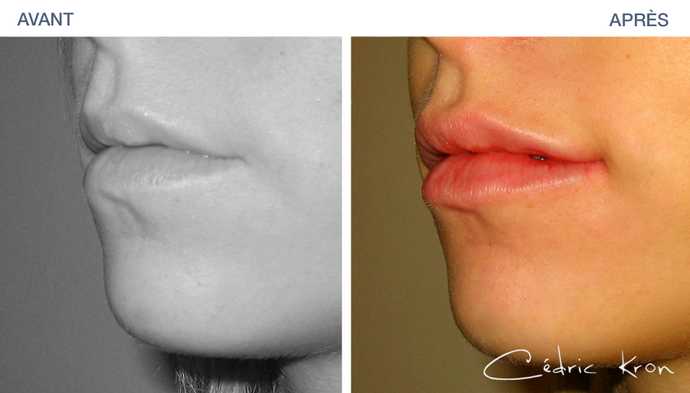
Result of a lip volume increase:
The result of the procedure can be assessed immediately after the treatment. The injections are only slightly painful, often completely painless. Only redness and slight swelling at the injection sites may be present for a few minutes to a few hours. More rarely, a small bruise may appear, but this is easily covered with makeup. A normal return to daily activities is possible immediately after the procedure.
Hyaluronic acid is a resorbable product. As such, its effect tends to fade over time. The longevity of the result varies depending on the mobility and skin depth of the injected area and the type of product used.
Generally, the result of a hyaluronic acid injection lasts about 12 months.
An injection of filler is contraindicated in the following cases:
- Ongoing inflammatory skin conditions (to be treated beforehand)
- Autoimmune disease
- Recent use of aspirin or corticosteroids
- Pregnancy, ongoing breastfeeding
Why have this procedure performed by a plastic surgeon?
Since a hyaluronic acid injection is an aesthetic medicine procedure and not a cosmetic surgery procedure, it can be performed by other practitioners.
Plastic, cosmetic and reconstructive surgery is the ONLY medical specialty recognized in France that trains practitioners in the full range of possible medical and surgical aesthetic treatments. A plastic surgeon is therefore able to offer patients a comprehensive diagnostic and therapeutic approach. Through his surgical training, he also has expertise in facial anatomy, which he has studied layer by layer, which he explores daily through his surgical techniques, and which he continues to study through ongoing medical training and teaching courses.
The knowledge of facial anatomy acquired during his training, along with the experience gained through the facial surgery procedures he has performed, gives him a three-dimensional mastery of the face. He therefore knows exactly in which part of the face to perform the injections, based on the expected result and each patient's anatomy.
As a cosmetic surgeon, he will be able to explain and offer patients the therapeutic alternatives to hyaluronic acid injections, such as lipofilling, which fills volumes with injected fat, or a lip lift, which re-defines the lip border without increasing their volume.
Since each procedure has its advantages and drawbacks, a cosmetic surgeon can offer a response to the patient's wishes by optimizing the benefit/risk ratio.
Increasing lip volume with lipofilling
Lip lipofilling is a cosmetic surgery technique that involves reinjecting the patient's own fat to increase lip volume and plump them. It is a fat cell autograft, with fat harvested from the patient themselves being reinjected.
The advantage of this technique over lip augmentation with hyaluronic acid lies in the longevity of the result achieved. The self-grafted fat cells remain alive, providing a stable result over several years.
Principle of lip lipofilling
Lipofilling is a technique that re-injects autologous fat, meaning it uses the patient's own fat.
The surgeon begins by identifying the fat harvesting areas as well as the reinjection sites. Then, fatty tissue is harvested through a micro-incision using a fine suction cannula. The fat cells are taken from a discreet area of the body where there is a reserve, or even an excess, of fat cells (generally the abdomen, knees, inner thighs, or "saddlebags"). Very little volume is needed for the lips.
The harvested fat then undergoes a few minutes of centrifugation to separate the cells to be grafted (intact fat cells) from the elements that should not be grafted (fat cells destroyed during harvesting, non-fat cells such as blood cells).
The fat is reinjected using micro-cannulas equivalent to those used for hyaluronic acid injections.
The injections are performed in different planes and multiple directions so as to increase the contact surface between the grafted cells and the recipient (nourishing) tissues, allowing for good graft take.
The duration of the procedure can vary depending on the amount of fat to be injected and the number of areas treated. For an isolated lip lipofilling, the procedure generally lasts less than 30 minutes.
Recovery after lip lipofilling:
Depending on the patient and the procedure performed, simple local anesthesia or, more rarely, general anesthesia may be considered. General anesthesia is more commonly used when lip lipofilling is combined with another cosmetic surgery procedure.
The procedure is generally performed on an outpatient basis.
Postoperative pain is very moderate in most cases.
It is normal for edema to appear within 48 hours after the procedure. This will fully resolve within 5 to 15 days following the procedure.
Bruising appears at the harvesting and reinjection sites. These bruises fade within 5 to 21 days.
Since the injected fat is harvested from the patient themselves, lip lipofilling never causes allergic reactions and there can be no rejection.
Smoking increases the risk of surgical complications in any type of surgery. Stopping smoking 6-8 weeks before the procedure eliminates this additional risk. If you smoke, talk to your doctor, surgeon and anesthesiologist, or call a smoking cessation helpline to help reduce risks and give yourself the best chances.
The result:
The result of lipofilling can be assessed once the edema and bruising have resolved. In the case of lip lipofilling, the edema resolves within a few days. The result can be considered final after 3 to 6 months.
Lipofilling achieves a lasting result because it is a genuine autograft of the patient's own cells. The grafted fat cells remain alive for as long as the tissues in which they were grafted. There can be a loss of 10 to 30% of the reinjected fat volume. The surgeon takes this phenomenon into account when assessing the amount of fat cells to graft. After 6 months, a touch-up lipofilling procedure may be considered to achieve the desired volume increase.
Smoothing perioral wrinkles with a peel
A lip peel (or "chemical dermabrasion") is an aesthetic technique that reduces deep perioral wrinkles. This technique regenerates the superficial layers of the skin through chemical action.
Principle of a perioral peel
There are different types of peels (light, medium, deep). For lip treatment, a light or medium phenol peel, depending on skin condition, very effectively and significantly reduces wrinkles thanks to its "lifting" effect. A phenol peel can correct wrinkles, fine lines and skin laxity around the lips at the same time.
A phenol peel triggers a complete renewal of the epidermis in the treated area as well as regeneration of the dermis, resulting in smoother skin and the disappearance of wrinkles and spots.
This peel is indicated for women and men with wrinkles, spots or scars around the perioral area whose skin tone is not too dark.
A lip peel is performed under local anesthesia in about half an hour.
Recovery after a lip lift
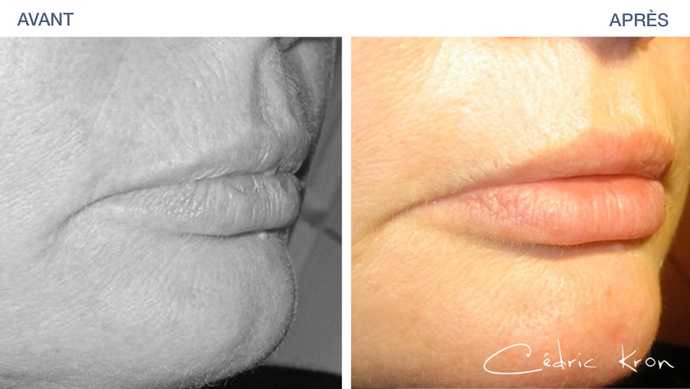
The result appears gradually over the weeks following the procedure.
Recovery after a peel is initially marked by the presence of scabs for 4 to 8 days (4-5 days for a light peel, 5-7 days for a medium peel), which must be treated with the application of a fatty ointment. Once the scab disappears, red skin appears, which gradually becomes pink before returning to its original tone after a few weeks.
Applying appropriate covering makeup allows for a very quick return to daily activities, as soon as the scabs have disappeared.
For the two months following the procedure, it is essential to apply full sun protection to the treated area. The result of a peel is lasting and natural (the patient's original facial harmony is not altered).
A peel may sometimes be combined, in a separate procedure, with a lip augmentation procedure such as a hyaluronic acid injection or lipofilling. It can also be used on other areas of the face.
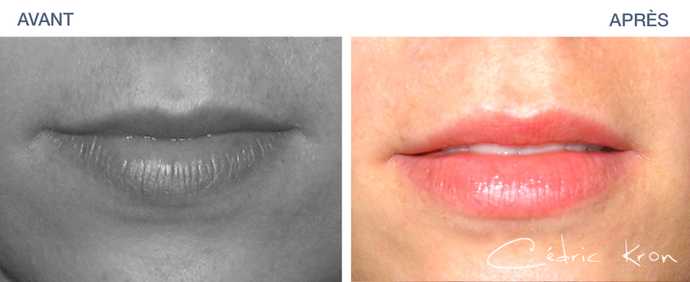
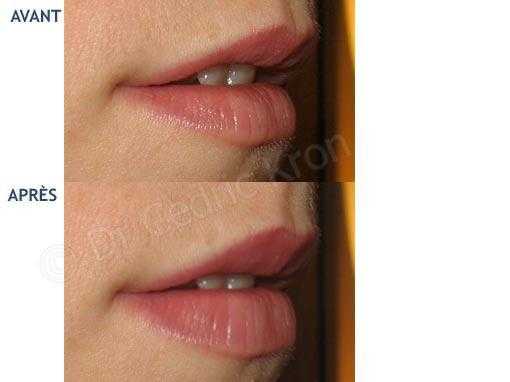
Before-after: aesthetic lip treatments
> See the before-after gallery dedicated to aesthetic lip treatment
