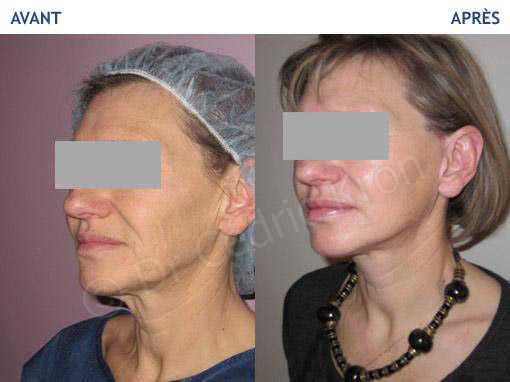
A cervicofacial facelift is a procedure that rejuvenates the face by correcting wrinkles or sagging in certain areas. Each area of the face can be reshaped in a specific way to preserve its authenticity and uniqueness, avoiding the trap of standardization.
A cervicofacial facelift that combines different cosmetic surgery techniques (facelift, lipofilling, liposuction) and aesthetic medicine techniques (Botox injections, hyaluronic acid) generally achieves a more lasting and natural result. These techniques can be spread across several procedures over time.
1. A natural face and neck lift for rejuvenation
Note: This page covers the different "beautification" treatments for the face offered by Dr. Cédric Kron. For more information about these cosmetic surgery and aesthetic medicine techniques, consult the following links:
- LVPA facelift
- Deep plane facelift
- Forehead lift
- Neck lift by platysmaplasty
- Filling facial wrinkles with hyaluronic acid
- Removing forehead wrinkles with Botox injections
- Forehead and eyebrow rejuvenation
- Face and neck liposuction
A facelift is indicated for women and men who wish to restore the contour of their face, lift cheeks that have gradually sagged, regain well-defined cheekbones, reduce jowls, nasolabial folds, or a somewhat lax or thickened neck.
Some women feel that their face looks aged even though they don't feel that same aging in the rest of their body. A facial rejuvenation procedure restores the balance between the reflection in the mirror and the rest of the body.
A natural facelift, free of surgical "signature" and with concealed scars, can achieve a "rejuvenation" of 5 to 10 years. But the goal, more than rejuvenation, is to enhance beauty by restoring the harmony that the patient wants to feel — the balance between their physical state, their state of mind and their face.
2. Understanding the different facelift techniques
The term "facelift" refers to all procedures aimed at correcting skin sagging. A facelift must be adapted to the area to be tightened based on the patient's wishes.
In recent years, facial rejuvenation techniques have made progress in minimizing risks, recovery time and scarring, notably due to aesthetic medicine treatments. These have the advantage of being more effective, as they physiologically address the problem of ptosis (tissue sagging) caused by the effect of gravity. They effectively reposition tissues to their "former" place in a natural way.
There are different types of facelifts depending on the areas of the face treated.
- Temporal lift, which involves pulling on the cheekbones and the corner of the eyes.
- Eyebrow lift, also performed via the upper temporal area
- Cervicofacial lift (also called "facial oval lift," "facial oval and cheekbone lift," etc.), which treats the cheeks (or jowls) as well as the neck
- Forehead lift, which corrects sagging of the skin and muscles of the forehead.
Facelifts performed before the arrival of new techniques in the 21st century had the drawback of causing significant recovery (edema, bruising and scars). Now, to minimize these drawbacks, facial rejuvenation combines different techniques, whether surgical techniques with concealed or minimally invasive scars (lipofilling, liposuction) or aesthetic medicine techniques (filling, Botox). These techniques vary in surface area and depth.
Depending on the patient's anatomy and wishes, a facial rejuvenation procedure can combine a lift (cheek, cervical, cheekbone, forehead, temporal), lipofilling, liposuction and/or a botulinum toxin injection. The surgeon must listen to the patient's wishes and offer a suitable response for the best result and the best benefit-risk ratio.
It should be noted that all facelifts performed by Dr. Cédric Kron are deep anterior vertical facelifts (LVPA), which naturally correct facial sagging and reposition volumes, with nearly invisible scars and a return to social life in under a week, all while offering a lasting result over time.
Each rejuvenation technique addresses certain aspects of facial aging:
- A cervicofacial lift is the most suitable response for correcting a face that is "sagging" under the effect of gravity.
- Lipofilling techniques are particularly indicated for areas that are "hollowing" (cheekbones, lips, temples) without laxity. They can be replaced, when volumes are moderate, by hyaluronic acid filling techniques (e.g., Restylane, Juvederm Ultra…)
- Facial liposuction techniques correct the thickening of certain areas of the face (jowls, submental area), restoring a more even, oval facial shape.
- Botulinum toxin (Botox) naturally corrects the effects of aging on facial muscles and certain wrinkles linked to these muscles.
Combining techniques generally ensures a more lasting and natural result.
3. Recovery after a cervicofacial facelift
The type of anesthesia used for a facelift depends on the type of lift performed:
- For localized lifts (correcting a facial oval that is starting to deteriorate, a cheekbone, or a somewhat pronounced nasolabial fold), strict local anesthesia is possible, often assisted by anesthetic sedation for the patient's greater comfort and safety.
- Most often, a facelift is performed under assisted local anesthesia with sedation, or assisted with controlled general anesthesia. This type of anesthesia allows for very quick recovery as well as a gentle wake-up.
A facelift generally involves an overnight hospital stay. When the surgical procedures are more limited, hospitalization can be on an outpatient basis.
As with any surgical procedure, a cervicofacial facelift carries risks, even though these are limited. It is the surgeon's role to explain to the patient the risks involved based on the combination of techniques used to achieve the desired result.
To prevent risks, a blood test is required prior to the procedure. Depending on age and associated risk factors, a cardiovascular assessment may also be necessary.
As part of a comprehensive cosmetic, medical and aesthetic approach to facial skin aging, Universkin serums may be prescribed before and/or after a facelift, to prepare the skin and optimize the result achieved.
Universkin is a functional dermatology protocol that creates custom cosmetic prescriptions, whose active ingredients and dosage are determined after a complete diagnostic of your skin's condition.
Smoking increases the risk of surgical complications in any type of surgery. Stopping smoking 6-8 weeks before the procedure eliminates this additional risk. If you smoke, talk to your doctor, surgeon and anesthesiologist, or call a smoking cessation helpline to help reduce risks and give yourself the best chances.
4. Before - After: cervicofacial facelift:
> See before-after photos of a facelift