
A skin-and-muscle platysmaplasty can be considered a neck lift, as its goal is to fight the signs of time by redraping the lax skin and muscles of the neck. While it can be performed on its own to treat very localized neck laxity, it can also be combined with the LVPA facelift technique to achieve a very significant and lasting rejuvenation of the facial oval.
In brief: Platysmaplasty - Neck lift
- Indication: Correcting skin and muscle laxity of the neck, combined with visible wrinkles or platysmal bands.
- Combined procedure: LVPA facelift
- Result: Natural within a few days - Final after 6 months (on average)
- Anesthesia: General with laryngeal mask or assisted local anesthesia
- Pain: 1 to 2/10
- Scars: Discreet, under the chin
- Recovery: Between 5 and 15 days
- Return to sport, sun, swimming: 2-3 weeks after the procedure on average
- Average operative time: 1 hour
- Hospitalization: Outpatient clinic
What is the platysma muscle?
The platysma muscle (also called the neck's subcutaneous muscle) is a thin, wide muscle located under the skin of the neck, extending from under the décolletage skin and ending in a fixed aponeurotic sheet at the cheekbones.
It is a superficial muscle, meaning it is located immediately under the skin and is not covered by other muscles. The platysma muscle is involved in several movements of the face and neck and plays an important role in facial expressions.
Effects of aging on the platysma muscle
With age and tissue aging, the platysma muscle can lose tone, which contributes to skin laxity in the neck. This can result in the appearance of wrinkles and folds, along with stretched skin around the neck.
In some cases, "platysmal bands" can form: the muscle fibers of the platysma become more visible and form vertical and/or horizontal bands in the neck, often associated with neck aging.
Generally speaking, laxity of the platysma muscle contributes to a loss of definition of the facial oval, and even to fat accumulation around the chin (double chin).
Principle of a neck lift
A skin-and-muscle platysmaplasty can be considered a neck lift, as its goal is to fight the signs of time by redraping the lax skin and muscles of the neck.
Indications for a platysmaplasty
A platysmaplasty is indicated for patients who wish to redefine the oval of their face around the neck and chin. It is intended for people who wish to reduce platysmal bands and achieve a smoother, more natural neck. A skin-and-muscle platysmaplasty may also be indicated for people who have a double chin.
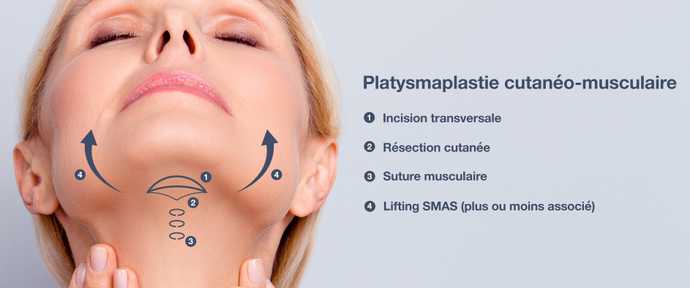
Surgical technique: Skin-and-muscle platysmaplasty
When the neck angle is not very pronounced, the platysma muscle is lax and/or the horizontal skin of the neck is lax in a localized way, the surgeon can perform a neck lift by skin-and-muscle platysmaplasty.
A skin-and-muscle platysmaplasty involves making a transverse incision below the bony rim of the chin to re-tension, through direct access, the platysma muscle of the neck at this level, like a "corset."
If localized fat deposits are present, these are resected during the procedure. It should be noted that these fat deposits are located behind the muscle and are therefore not accessible by liposuction.
Once the muscle re-tensioning has been performed, the surgeon proceeds to a skin re-tensioning through localized resection of the submental skin.
Combining platysmaplasty with an LVPA facelift
A neck lift (skin-and-muscle platysmaplasty) can be performed on its own for very localized neck laxity.
If neck laxity is accompanied by more general facial tissue laxity, a very significant and natural result can be achieved by combining a neck lift with a facelift, notably the LVPA facelift technique.
The LVPA facelift (Long Vertical Deep Anterior) was developed by Dr. Cédric Kron, who has had the opportunity to present it at several scientific congresses. He was elected a Member of the National Academy of Surgery following the presentation of this technical innovation. This technique corrects deep tissue laxity through traction on the SMAS (superficial musculo-aponeurotic system). By preserving all the connections between the skin and the SMAS, the LVPA facelift achieves a more natural, more lasting result with faster recovery than a traditional cervicofacial lift.
Since the platysma muscle is part of the SMAS, which is undermined (deep plane face-lift) and "re-tensioned" as part of an LVPA facelift, a skin-and-muscle platysmaplasty can be combined with an LVPA facelift in the same procedure to create an even more defined neck angle. This combination achieves a natural, lasting rejuvenation of the facial oval with very fast return to social life.
> Learn more about the LVPA facelift
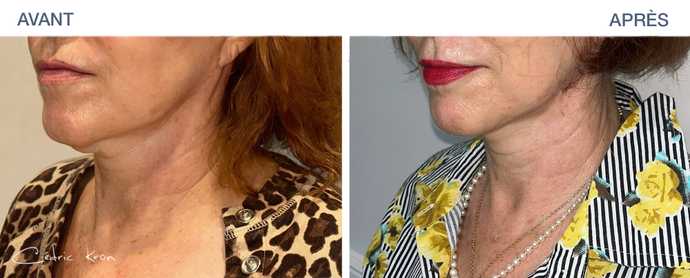
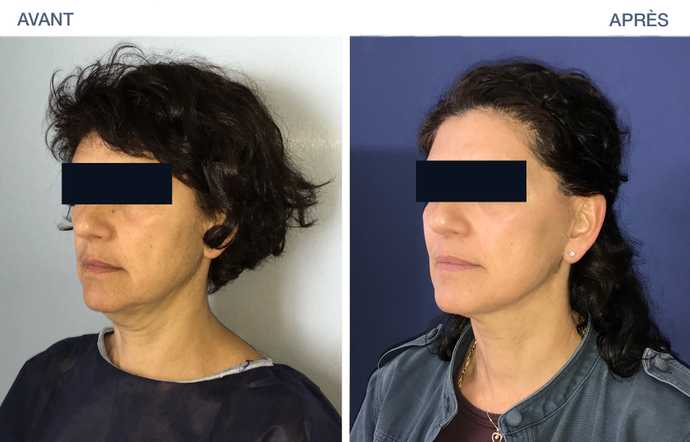
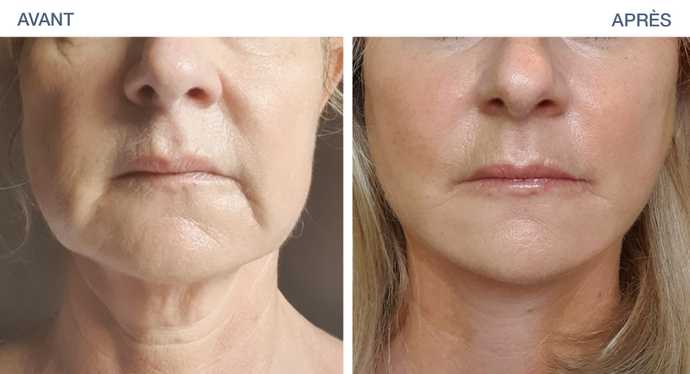
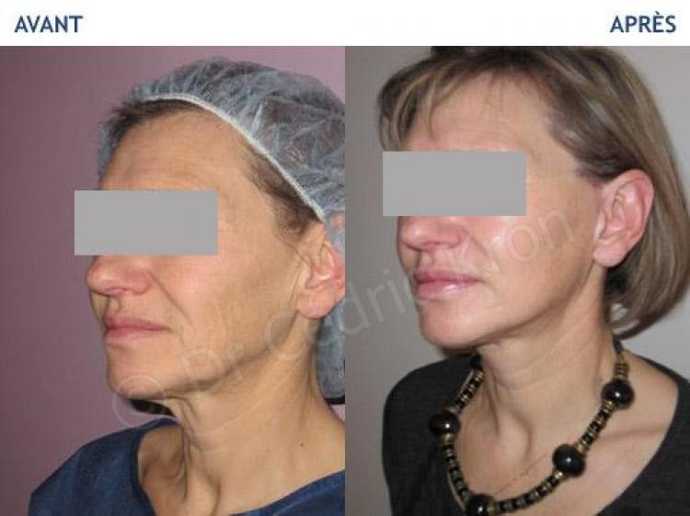
Before-after: Neck lift by platysmaplasty
Learn more:
> Before-after gallery dedicated to the LVPA facelift
> Before-after gallery dedicated to double chin treatment
> Video: Presentation of the LVPA facelift technique at the National Academy of Surgery
