
A lower blepharoplasty is a cosmetic surgery procedure on the lower eyelids, similar to an "eye-area lift". Its goal is to durably rejuvenate the eyes by removing the imperfections of the lower eyelids that give the eyes a tired appearance. A lower blepharoplasty can notably correct the presence of hollow circles and fatty bags under the eyes.
What is a lower blepharoplasty?
Definition
The term "blepharoplasty" refers to the full range of cosmetic surgery procedures concerning the eyelids. A blepharoplasty removes imperfections of the eye area at the eyelids, whether hereditary or resulting from tissue aging.
A lower blepharoplasty involves restoring natural tension to the structures of the lower eyelid, resecting excess skin, orbicularis muscle and fat (fat herniation) if needed. Sometimes lipofilling of the under-eye area is combined with it to treat a hollow circle.
Generally speaking, a lower blepharoplasty corrects a "tired" appearance caused by excess skin or the presence of circles or bags under the eyes.
Indications
A lower blepharoplasty is indicated for people who wish to:
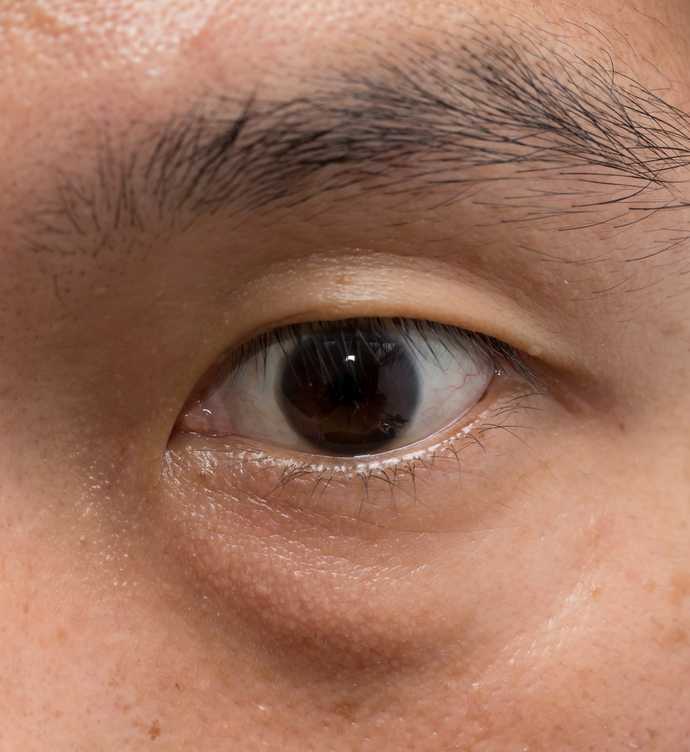
- Correct hollow circles caused by tissue aging,
- Remove excess fat responsible for "bags" (fat herniation),
- Correct drooping eyelids and wrinkles caused by skin laxity,
- Restore tension to tissues affected by age-related laxity,
- Restore more symmetry to the eyes when tissue laxity is uneven between eyelids.
A lower blepharoplasty can be performed on women and men from the first signs of aging. The procedure can be performed earlier in people who have fatty bags or circles of hereditary origin.
A lower blepharoplasty can be performed on its own or combined with other facial cosmetic surgery procedures (notably a cheek lift, an LVPA facelift, or a forehead lift).
Surgical options for a lower blepharoplasty
The choice of technique depends on the extent of excess skin on the lower eyelids. During a consultation with your cosmetic surgeon, they will be best placed to explain which surgical option is best suited to your anatomy and aesthetic goals.
In the absence of excess skin: transconjunctival approach
If there is no excess skin, the procedure can be performed from inside the eyelid. This is referred to as a lower blepharoplasty via the transconjunctival approach.
This surgical option has the advantage of leaving no scar on the skin. Recovery is also simpler than with other techniques.
During the procedure, the excess fat responsible for the bags is removed. The circles are sometimes filled by re-using the excess fat responsible for the bags, so as to even out the fat layer along the bony rim of the eye socket. This repositioning of the sub-orbital fat effectively treats the circles without involving any scar.
In case of skin laxity: incision along the lash line
If the skin of the lower eyelids is lax, an incision is made along the lash line.
It is from this lash-line incision that the excess fatty tissue is removed and the fat is "spread out" to fill the circles.
The excess skin is then smoothed through careful redraping of the skin. It is indeed essential not to apply tension to an area as delicate as the eyelid margin.
In case of significant skin laxity: cheek lift
When there is pronounced tissue laxity, particularly a malar pouch below the eyelid pocket, a cheek lift (also called centrofacial lift) is generally a better option. It achieves a more natural and more significant result on skin laxity.
A lift involves an incision, and therefore a scar, in the temporal hairline area. This scar is generally small and largely hidden by the hair.
> Learn more about the cheek lift
Recovery after a lower blepharoplasty
Anesthesia
In most cases, a blepharoplasty is performed under local anesthesia administered by the surgeon themselves. It can sometimes be performed under assisted local anesthesia with an anesthesiologist (NLA, or neuroleptanalgesia) or under light general anesthesia with a laryngeal mask.
Hospitalization:
The procedure is most often performed on an outpatient basis. When the blepharoplasty is combined with other surgical procedures (cheek lift, cervico-facial lift, etc.), an overnight hospital stay may rarely be necessary.
Is this a painful procedure?
A blepharoplasty does not cause real pain, but some discomfort: a feeling of tightness in the eyelids, slight eye irritation. Rest is needed for the first three days, avoiding any significant exertion.
Recovery is mainly marked by the appearance of edema (swelling) and bruising, the extent and duration of which vary depending on the patient, the technique used and how it is performed by the surgeon.
Recovery after a lower blepharoplasty:
The signs of the procedure gradually fade, allowing a return to normal daily life after a few days (5 to 15 days depending on the individual and any combined procedures). Scars may remain slightly pink during the first few weeks, but eyelid makeup can usually be worn quickly (typically from day 7). Slight firmness in the areas that were undermined may persist for a few months, but this is not noticeable to others.
During the first few days, it is sometimes possible to observe an inability to fully close the eyelids, or a slight detachment of the outer corner of the eye that no longer sits perfectly against the eyeball. These signs are generally quickly reversible.
Risks:
A blepharoplasty carries few risks. It is nonetheless a surgical procedure that carries the risks inherent to this type of medical procedure (anesthesia, asymmetry, infections).
It should also be considered that smoking increases the risk of complications and complicates healing. The risk of ectropion (rounded eye) exists only in case of a skin incision; it does not occur with the transconjunctival approach.
Results of a lower blepharoplasty on bags and circles
Due to the presence of postoperative edema and bruising, it is not possible to judge the result immediately.
After about ten days, a good idea of the result can be seen, and the signs of the procedure will be nearly invisible.
The final result can be assessed within 3 to 6 months, the time needed for the tissues to regain their full suppleness.
A lasting, natural result
A blepharoplasty corrects the presence of circles and bags under the eyes in a completely natural way. Once the excess skin and muscle are removed and the tissues re-tensioned, the eyes regain their original harmony.
Generally speaking, the result of a lower blepharoplasty is particularly long-lasting. Since the procedure removes the bags, they usually do not return for several years. This type of procedure is said to last about 10-15 years depending on aging.
Scars
The size and placement of the scars depend on the procedure performed. Dr. Kron uses the transconjunctival approach whenever possible for the lower blepharoplasties he performs.
A transconjunctival lower blepharoplasty has the advantage of leaving no visible scar. This technique also significantly limits the side effects described above.
