
Caused by an excess of melanin, pigmented (brown) under-eye circles can be corrected with a peel treatment. A depigmenting-type peel offers the best results on brown circles. This type of peel acts directly on the hyperpigmentation and melanin responsible for brown circles while stimulating cell regeneration.
What causes pigmented (brown) under-eye circles?
Pigmented circles are most often brown, but they can also take on a coloring tending toward yellow.
Brown circles are caused by melanin deposits located under the skin. These deposits are produced by melanocytes, cells essential to our body, whose function is to protect the organs under the skin from UV rays. Melanin is responsible for the color of our skin, hair and eyes. It is also what gives our skin its tan.
Pigmented circles tend to appear more often in patients with darker skin tones (particularly patients from North Africa, the Middle East or Southeast Asia). Hereditary predispositions may also explain the appearance of brown circles.
What is a peel?
A peel is an aesthetic medicine technique that involves applying chemical products to the skin to trigger exfoliation (removal of dead cells) and thereby stimulate cell regeneration.
The different types of peels
There are generally three types of peels (superficial, medium and deep) using active ingredients of varying strength: fruit acids, trichloroacetic acid (TCA), phenol.
Generally speaking, the deeper the peel, the more significant the result, but the greater the side effects. A deeper-acting peel therefore involves a longer period of social downtime. A phenol peel can be quite effective, but it involves recovery that is too demanding (peeling, scabbing) and risks that are too significant (permanent depigmentation) to be recommended by Dr. Kron.
Less downtime than in the past
Dr. Kron performs latest-generation combined peels that combine carefully selected exfoliating chemical agents to treat the main skin conditions with an optimal efficacy and safety profile.
Dr. Kron also performs the PRX-T33 biorevitalizing peel, which stimulates skin regeneration without involving exfoliation of the epidermis.
> Learn more about the different types of peels
Specifics of a depigmenting peel
A depigmenting peel is a light or medium-type peel that targets melanin deposits under the skin and regulates the body's melanin production.
It can treat brown circles, but also sun spots and age spots (lentigos).
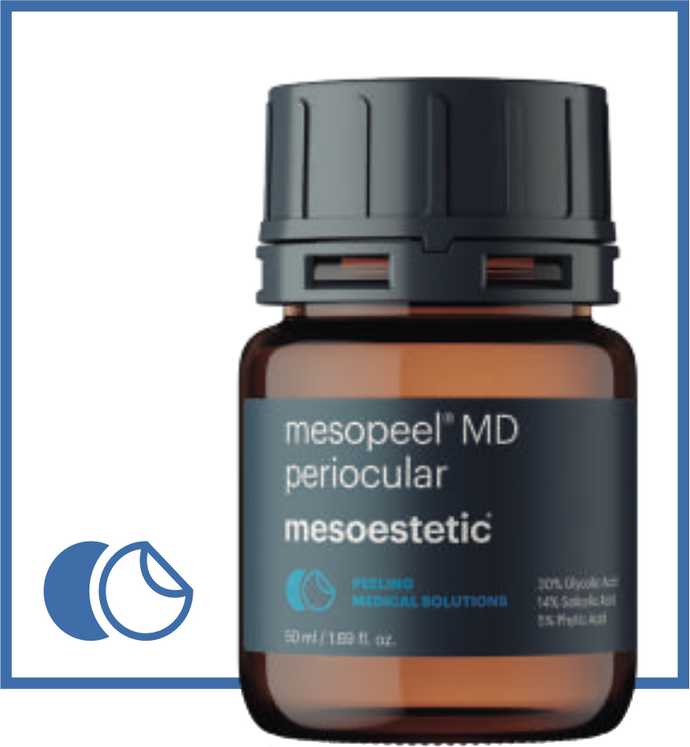
For peels aimed at correcting pigmented circles, Dr. Cédric Kron favors the MESOPEEL® MD PERIOCULAR peel, which is particularly suited to treating signs of aging in the peri-ocular area, reducing expression lines and improving the appearance of circles. It is made up of 30% glycolic acid, 14% salicylic acid, 5% phytic acid, thioctic acid, caffeic acid and coumarin.
What happens during a peel treatment for circles
A depigmenting peel treatment differs somewhat from a traditional medium peel.
Before the peel
The skin needs to be prepared ahead of a peel for pigmented circles: a depigmenting cosmetic preparation that puts the melanocytes to rest is applied to the treated area for the 15-21 days preceding the peel.
What happens during a depigmenting peel
The product is applied to the circles using a swab. The number of layers (generally 2) and the exposure time are determined based on your skin type and type of pigmentation. In addition to the peel, mesotherapy may be performed to optimize the result.
After the peel
Following the peel, a depigmenting cream must be applied daily for at least one month after the treatment.
After a depigmenting peel, it is essential to apply full sun protection (SPF 50+) for 2 to 3 months whenever the treated area may be exposed to the sun.
Number of sessions
For an optimal result, 3 to 5 sessions of the MESOPEEL® MD PERIOCULAR peel are recommended, with an interval of 15 days between sessions.
Results of a depigmenting peel on brown under-eye circles
The result of a depigmenting peel on brown circles appears gradually one month after the treatment. The result develops as the skin progressively regenerates following the peel and with daily application of the depigmenting cream.
On which skin types?
The result of a peel for pigmented circles can be seen on all skin types, including on Black and mixed-race skin, which is most often prone to brown circles.
Like all peels, the treatment also acts on skin radiance, fine lines and skin imperfections, regardless of skin type.
How long does the result on pigmented circles last?
To maintain the result, maintenance peels are necessary. A circle peel every 12 months generally maintains a fully satisfactory result.
At the practice, we offer custom-formulated serums (based on an analysis of your skin using research-derived diagnostic tools) which, through their depigmenting, antioxidant and dermis-restructuring effects, can reduce your under-eye circles.
To help determine whether a peel treatment matches your needs and expectations regarding the correction of your brown circles, the practice offers a face diagnostic consultation. During this diagnostic, an in-depth assessment of your facial skin will help develop a tailored treatment protocol for your pigmented circles.
