
Hollow under-eye circles can be corrected with an injection of a filler such as hyaluronic acid along the bony rim of the eye socket, beneath the eyelid muscle. Hyaluronic acid injections restore the missing volume under the eyes by filling the hollow responsible for the circles. The result of filling under-eye circles with hyaluronic acid is natural and immediate, but maintenance injections are needed to sustain it over time.
In summary: Filling hollow under-eye circles
- Indication: Filling hollow under-eye circles with hyaluronic acid injections
- Result: Immediate. Optimal after one week. Lasts 6 to 12 months.
- Anesthesia: None
- Pain: Painless (0 to 2/10)
- Scars: None
- Recovery: Slight redness for a few minutes, sometimes mild edema
- Return to sport: The following day
- Duration of the procedure: 15 - 30 minutes
- Location: Medical practice
What is hyaluronic acid?
Hyaluronic acid is a glycopeptide naturally present in the skin that has three essential functions:
- Skin hydration (it can retain up to 1000 times its weight in water),
- Maintaining the skin's three-dimensional structure,
- Skin elasticity.
Its hydrophilic and three-dimensional properties allow it to compensate for missing volume.
The hyaluronic acid manufactured by the laboratories used by Dr. Kron is a pure, synthetic, non-animal-derived hyaluronic acid gel, which is broken down naturally by the body just like the hyaluronic acid your body produces on its own, through enzymes called hyaluronidases. Hyaluronic acid is notably very effective for filling facial wrinkles.
How effective is hyaluronic acid on hollow circles?
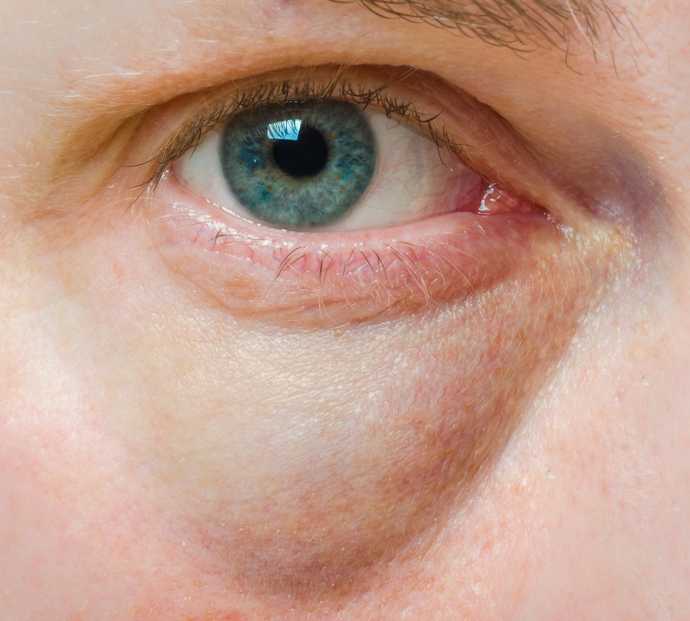
Hollow circles are caused by the aging of facial tissues. They appear in an area naturally filled with fat whose role is to protect the eye.
As we age, the loss of fat and muscle volume in this area leads to a loss of volume as well as a shift of fatty tissue from the lower eye-socket rim upward toward the cheekbones. This fat then forms a half-circle groove under the eye, which can be more or less extensive. The hollow appearance of this groove is reinforced by an optical effect that darkens the circle.
Through its hydrophilic effect, hyaluronic acid can fill the missing volume in hollow circles and thus reduce them in a completely natural way.
Since the skin under the lower eyelid is particularly thin, the injection is performed deeply, against the orbital bone, to avoid surface irregularities.
For filling hollow circles, it is preferable to use a lightly cross-linked hyaluronic acid, meaning one with a weaker volumizing effect. This helps avoid the formation of small unsightly "lumps" directly under the skin.
What happens during hyaluronic acid treatment of hollow circles
The procedure is performed directly at the consultation practice. The injection session lasts between 15 and 30 minutes depending on the characteristics of the hollow circles being treated.
The injections are only slightly painful, even though the eye area is a particularly sensitive area. Dr. Kron uses a micro-vibration device that reduces the sensation of the needle pricks and makes the session virtually painless.
After the procedure, it is advisable to avoid exposure to extreme cold or intense heat. Massaging or touching the periorbital area should also be avoided. Makeup can be applied the following day.
Only redness and slight swelling at the injection sites may be present for a few hours, and more rarely bruising (easily covered with makeup). A normal return to daily activities is possible immediately.
Results of a hollow circles treatment
When is the result visible?
The filling of the circles can be assessed immediately after the hyaluronic acid injections. The final result of the procedure appears gradually over a few days.
Immediately after the procedure, slight redness or mild edema may be observed at the injection site. These side effects naturally disappear after a few hours. More rarely, bruising may appear (which can easily be covered with makeup).
How long do hyaluronic acid injections last?
It should be considered that hyaluronic acid is naturally and progressively broken down by the body. The injected hyaluronic acid is gradually "consumed" by the body as it "retains water". The effect of the injections thus tends to fade over time.
The longevity of the result varies depending on the mobility and skin depth of the injected area and the type of product used. Generally, the result of a hyaluronic acid injection lasts about 6-12 months, depending on the product used. After that, maintenance injections are needed to sustain the result.
Risks:
Hyaluronic acid is a substance naturally produced and used by the body. No test is required before injection, as it is not a particularly allergenic substance. Hyaluronic acid injections to fill under-eye circles are perfectly well tolerated by the body. Hyaluronic acid injections therefore carry no significant risk.
The only risk is possible over-correction if too large a quantity of hyaluronic acid is injected. The patient would then present a slight swelling in place of the hollow that was meant to be corrected. A doctor experienced with this type of injection will be able to precisely assess the quantity of hyaluronic acid to inject. Generally speaking, it is preferable to inject slightly less hyaluronic acid, even if it means performing a touch-up injection later, rather than risking over-correction.
Very rare cases of blindness have been described following injections in the under-eye area. A rigorous method performed by a specialist doctor helps limit this risk as much as possible.
Contraindications for hyaluronic acid injections
An injection of filler is contraindicated in the following cases:
- Ongoing inflammatory skin conditions (to be treated before any injection),
- Autoimmune disease,
- Recent use of aspirin or corticosteroids,
- Pregnancy or breastfeeding,
- History of acute rheumatic fever.
