
Buttock implants aim to achieve round, curvy buttocks and thus enhance the patient's femininity. Particularly popular in recent years, buttock implant placement has been refined with new techniques that achieve a more natural result and simpler recovery.
When to consider buttock implants?
Round buttocks and a harmonious silhouette
Having "flat buttocks" is often poorly accepted psychologically. This self-consciousness can undermine self-confidence and cause distress.
There are several criteria used to describe harmonious buttocks: degree of anteroposterior projection, lateral depression, shape of the sub-gluteal fold, V-shape of the proximal part of the intergluteal fold, or degree of lumbar curvature.
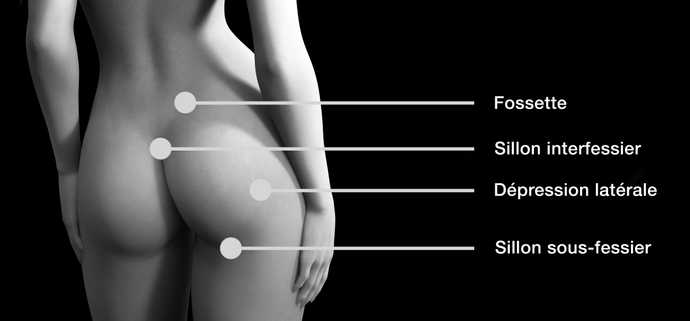
Buttocks considered flat show a lack of anteroposterior projection. It is specifically this lack of projection that can be corrected by buttock implants.
Buttock implant placement is an increasingly requested cosmetic surgery procedure. It is sometimes referred to as a "Brazilian butt lift," as this procedure is particularly popular in Brazil. The Brazilian butt lift is sometimes performed together with a buttock lift, which involves lifting the buttocks through an incision in the gluteal fold area.
While round buttocks have always been a marker of femininity, current standards of femininity and attractiveness increasingly value curvy buttocks, along with a fuller bust.
Which cosmetic surgery procedure to correct flat or simply small buttocks?
Several cosmetic surgery techniques are indicated for people who wish to correct "flat" or overly small buttocks. To increase buttock volume and redefine their contour, it is possible to use:
- Buttock implant placement: This is the technique that achieves the greatest volume.
- Lipofilling (or fat grafting): This procedure involves reinjecting the patient's own fat into the buttocks to create volume and redefine their contour.
- An injection of a hyaluronic acid-based filler, such as HYACORP Body Contouring.
- A fold lift through de-epidermization, which concentrates and rounds the lower part of the buttock.
- A buttock lift with a fat flap, which reconcentrates and rounds the upper part of the buttock.
Each technique has its advantages and drawbacks. These will be explained to you in detail during a pre-operative consultation. Dr. Kron will advise you on the therapeutic solution best suited to your anatomy and wishes.
Lipofilling, and even more so implants, are the most suitable techniques when it comes to significantly changing the shape of the buttocks while achieving a final result with minimal scarring.
Fillers achieve an increase in buttock volume without a surgical procedure (no hospitalization or general anesthesia). However, it should be considered that the result will be less significant and will not be permanent.

Indication for buttock augmentation with implants
Buttock augmentation with implants is indicated for women who are bothered, or even self-conscious, about buttocks they consider too small or too "flat" and who wish to lift "saggy" buttocks.
This may include women whose buttocks did not develop sufficiently during puberty, women who have experienced significant weight loss, or women whose buttocks have sagged due to tissue aging.
Buttock implants for men?
Both men and women can be self-conscious about buttocks that are "too" flat. Culturally and aesthetically, curvy buttocks are often considered an attribute of femininity, which explains why it is mainly women who opt for buttock implants.
However, a man may want greater projection in his buttocks. This is then less about achieving "rounded", "curvy" buttocks than a "muscular" and "athletic" backside. The volume and position of the implant will differ when placing buttock implants in a man.
Principle of buttock augmentation with implants
Choosing the type of implant
The choice of implant type is made with the surgeon during the pre-operative consultation. The shape and volume of the implants must match your wishes as well as your original anatomy. The surgeon will advise you to achieve a harmonious result matching your wishes.
Dr. Kron systematically uses highly cohesive silicone gel implants, which achieve a natural, lasting result while limiting post-operative risks.
Implant volume is generally between 200 and 450 cc. The choice of volume must absolutely be made with the surgeon during the consultation, as each person's anatomy is unique. Two patients would not achieve the same result by choosing implants of the same volume.
Scar position
To place the implants, one or two incisions are necessary. The position of these incisions determines the type of scar caused by the procedure.
- When the incision is made in the intergluteal fold, Dr. Kron makes two small 3-4 cm scars on either side of the intergluteal fold, offset from one another. This offers several advantages: no scar right in the middle of the more visible fold, two pockets entirely separated by two distinct scars, and better healing quality than at the middle of the fold. This is the type of incision used for all isolated buttock augmentations (without a lift).
- When the incision is made above the buttocks (when combined with a buttock lift), the scar is necessarily visible in the gluteal area.
Sub-muscular insertion
Dr. Kron uses the sub-muscular technique described by Dr. François Petit, a plastic surgeon in Paris, a fellow resident and friend for over 25 years who revolutionized this procedure — it is known as the SMS technique: Sub Muscular Safe.
What happens during the procedure
Buttock implant placement is performed under general anesthesia and generally lasts about an hour.
The procedure begins with infiltration of the surgical area with an anesthetic and vasoconstrictor product, which limits bleeding from small vessels and locally anesthetizes the surgical area. This allows for gentler general anesthesia and avoids pain upon waking.
The incisions used to place the implants are then made on either side of the intergluteal fold.
Dr. Kron then creates a space under the gluteus maximus muscle (undermining of the "pocket") using the SMS technique. Without going into technical detail, this creates a custom-fitted pocket without damaging the muscle. The implants are then inserted into this space before the incision is closed.
At the end of the procedure, sutures of the deep planes and the skin are made with resorbable thread. A waterproof, germ-proof dressing is applied, allowing you to shower every day without having to worry about it.
Recovery
Patients usually leave the clinic the same day as the procedure (outpatient hospitalization). In some cases, notably when buttock implant placement is combined with other surgical procedures, an overnight observation stay may be advised.
During the 48 hours following the procedure, it is normal to feel a sensation of tightness in the buttocks. This discomfort is generally relieved with painkillers prescribed by the surgeon.
Compression shapewear must be worn 24/7 for about 15 days.
After the procedure, a recovery period of 3 to 7 days should be observed. Return to sport should be gradual, starting 4 weeks post-operatively.
The procedure, in summary:
- Duration of the procedure: 1 hour
- Anesthesia: Combined general and local
- Hospitalization: Outpatient
- Recovery: Between 3 and 7 days
- Return to sport: Gradual from 4 weeks
- Scars: Discreet, hidden in the intergluteal fold
- Pain: 2-5/10
Results achieved with buttock implants
When can the result be observed?
The new buttock contour is visible from the moment you leave the clinic. However, the result cannot yet be considered final.
It takes two to three weeks for the bruising and edema caused by the procedure to disappear. It takes three to 6 months to achieve a final result, the time needed for the tissues to soften and for collagen to form. Indeed, it is necessary to wait for healing to complete, the skin to soften, and the implants to stabilize within the muscle.
It will take 6 to 12 months for the scars to no longer be inflamed.
Sensitivity in the buttocks gradually returns in the weeks following the procedure.
Refining the result of buttock augmentation with implants
In well-defined indications with a good match between the patient's anatomy and their wishes, buttock augmentation with implants achieves very good results. In most cases, the procedure achieves the desired result. However, it is possible to further optimize the result by combining another treatment with buttock augmentation with implants.
Preparing the gluteal muscle with EMSculpt
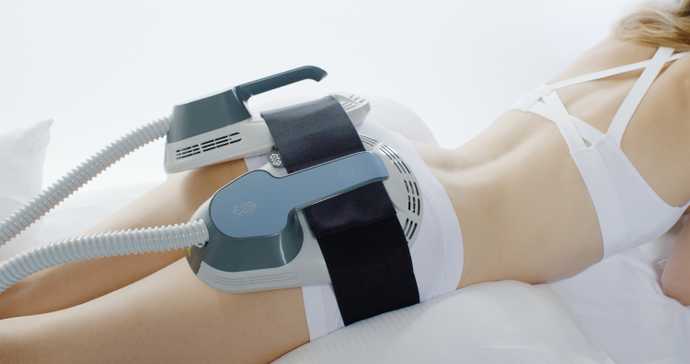
EMSculpt is a non-invasive, painless treatment that acts on both muscle mass and the excess fat surrounding it. EMSculpt sculpts the abdomen and firms the buttocks through this dual action. On average, 4 EMSculpt sessions reduce fat by 19% and increase muscle volume by 16% in the treated area. Often, in the buttock area, only the muscular component is treated so as not to lose the volume associated with fat.
Dr. Kron notably offers these patients EMSculpt sessions prior to buttock augmentation with implants. A few EMSculpt sessions develop the gluteal muscles before the procedure, to achieve optimal coverage of the implants. This both improves implant coverage and adds volume.
Removing excess fat and saddlebags by liposuction.
When fat deposits are present in the buttocks or saddlebags, buttock implant placement alone will not achieve the desired contour or a harmonious result. It is then possible to combine implant placement with liposuction in the same procedure. Lipofilling may also be combined, particularly to better fill the contours of the buttock and implant.
In case of significant skin laxity
When skin laxity is significant, it may be necessary to combine implants with a buttock lift (of the "butterfly" type). Repositioning the tissue then reshapes the buttock so that the implants create the best possible contour.
Before-after: cosmetic buttock surgery
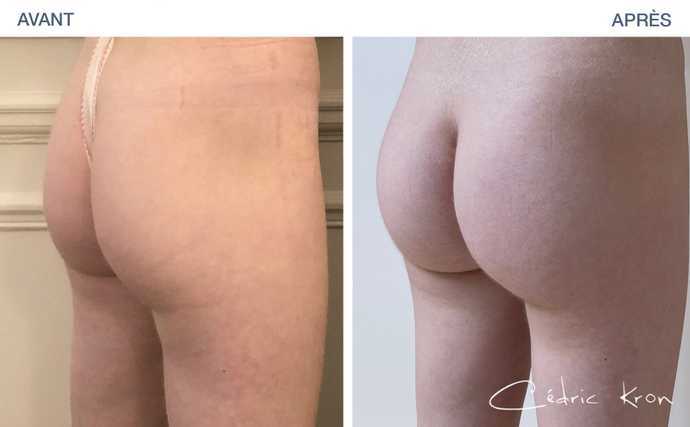
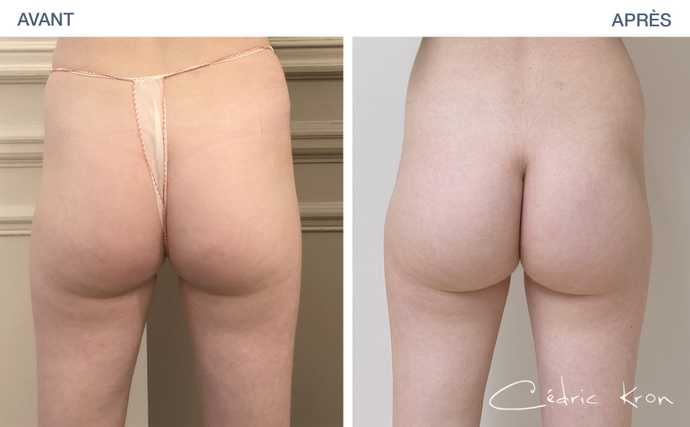
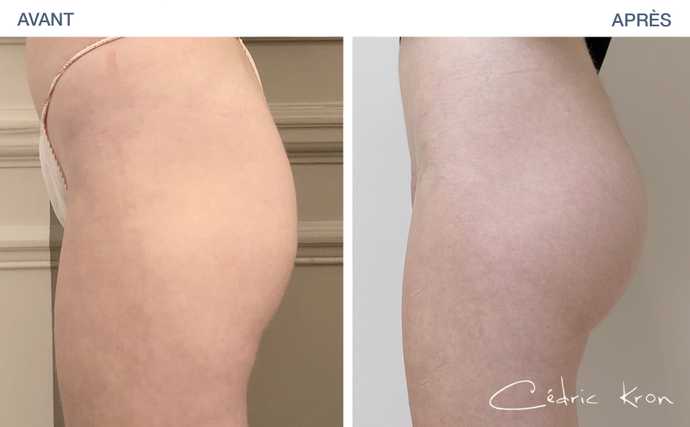
> The different cosmetic surgery procedures for buttock reshaping
> Before-after gallery dedicated to cosmetic buttock surgery
