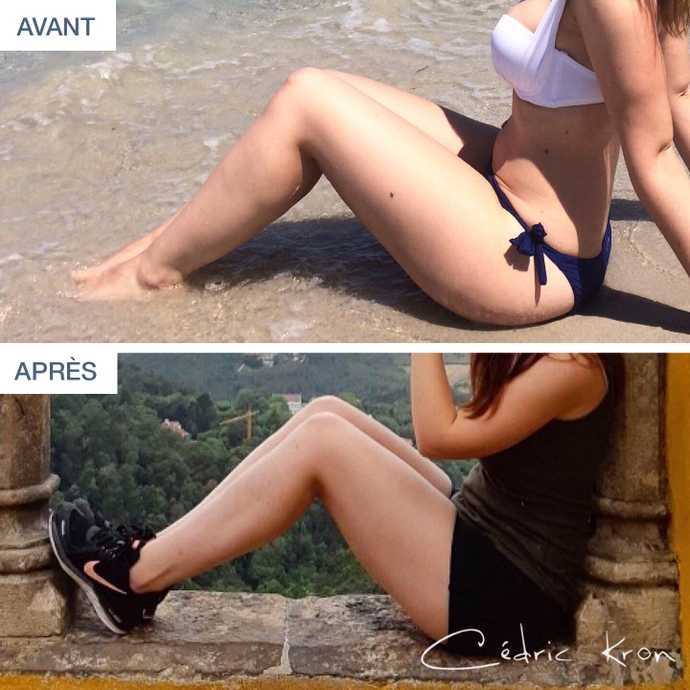
Calf liposuction is a cosmetic surgery procedure indicated for people with excess fat on the lower part of the legs and on the ankles. Often performed around the entire circumference of the calves as well as the ankles, this procedure slims and reshapes the calves to achieve a more harmonious silhouette.
In summary
- Principle: Slimming and reshaping the calves by removing excess fat to achieve more harmonious legs
- Result: Natural after 3 months, final after 6 to 12 months
- Anesthesia: General with laryngeal mask
- Pain: Between 2 and 4/10
- Scars: Mini-incisions on the legs, barely visible.
- Hospitalization: Outpatient
- Recovery: About 1 week
- Return to sport: Gradual from 3 weeks
- Duration of the procedure: About 90 minutes
Principle of calf liposuction
Calf liposuction aims to reshape the calves to achieve a harmonious contour and a more slender leg. A "heavy" appearance of the calf is generally accompanied by a thick ankle. This type of build can notably be observed in slim women. It is then constitutional and cannot be improved through dieting.
Calf liposuction cannot treat calves whose volume is explained by muscle mass or chronic edema. Liposuction can only treat calves with excess fat.
Liposuction permanently and radically removes localized fat deposits.
To find out whether you are a good candidate for calf liposuction, you can book an appointment for a body-contouring diagnostic.
What happens during liposuction
Calf liposuction involves inserting, through short incisions (3 to 5 mm), rounded-tip cannulas perforated with several openings at their end. The cannulas are connected to a closed circuit in which negative pressure is created, allowing for the suction of fat cells (deep and superficial) present in the calves and ankles.
Fat removal is performed evenly and circularly, while preserving a layer of fat beneath the skin to avoid any potential irregularities.
The amount of fat removed must be adapted to the quality of the overlying skin in the treated area. The skin is thus a determining factor in the quality of the result.
Due to the use of very fine cannulas, the appearance of the skin can be improved through the skin retraction that follows during healing.
Calf liposuction must respect the harmony between the contour of the gastrocnemius muscles and the ankle. The surgeon performing calf liposuction must therefore carry out a true "sculpture" of the calf.
Recovery
The procedure generally lasts between 1 hour 30 minutes and 2 hours.
Anesthesia
Calf liposuction can be performed under general, loco-regional (spinal, epidural) or assisted local anesthesia (neuroleptanalgesia), depending on the extent of the procedure.
Discomfort and pain are generally moderate; patients tend to describe it more as "discomfort." A feeling of fatigue may be felt in the days following the procedure. Pain is usually relieved with simple painkillers.
Bruising and edema
Bruising as well as edema usually appear in the treated areas.
Any changes in skin sensitivity resolve within a few weeks.
Drainage physiotherapy started in the days following the procedure is very useful for limiting these risks and promoting a faster, more comfortable recovery. It is even essential to best limit the risk of skin marks following bruising for several months.
Low risks
While complications following liposuction are rare, it should be considered a surgical procedure that carries the risks inherent to anesthesia and the medical act itself (see Risks in surgery).
Infections are extremely rare and are prevented with prophylactic antibiotic treatment.
In case of pain in a calf, phlebitis should be considered a possibility, requiring contact with the anesthesiologist or surgeon. A preventive anticoagulant is almost always prescribed for 10 days.
Smoking increases the risk of surgical complications in any type of surgery. Stopping smoking 6-8 weeks before the procedure eliminates this additional risk. If you smoke, talk to your doctor, surgeon and anesthesiologist, or call a smoking cessation helpline to help reduce risks and give yourself the best chances.
Results of calf liposuction
The result of the procedure takes longer to appear than for other areas treated by liposuction. The swelling inherent to any liposuction takes longer to subside. The final result is not seen before 3 to 6 months, due to the progressive nature of skin retraction and the time needed for the swelling to fully disappear.
To optimize the result of calf liposuction, XBody sessions may be indicated. This is a muscle electro-stimulation device particularly effective for reshaping the calf muscles and slimming the legs.
Compression tights are fitted after the procedure. These must be worn for at least 6 weeks after the procedure.
In some cases, localized imperfections may be observed: insufficient correction, residual asymmetry, surface irregularity. These imperfections can sometimes be treated during an outpatient "touch-up" procedure from the sixth month onward. They are not so much due to the surgeon's work as to the unpredictability of healing and any weight variations following the procedure.
Before - After: Calf liposuction