
Some women who have had breast augmentation may decide at some point in their lives that they wish to regain their original breasts or change their breast silhouette. While breast augmentation is a reversible surgery and implant removal achieves a very natural result, it is important that this decision be well thought out and made for good reasons. The surgeon will then offer the best possible technique suited to the shape and final volume to be achieved.
Why remove breast implants?
Breasts that no longer match…
Whether choosing to have implants placed or removed, it is always a highly personal choice. The goal is not to meet any particular beauty standard, but to achieve a harmonious breast silhouette that matches personal wishes and anatomy.
The image we have of ourselves can evolve over time. For some women whose breasts did not develop much during adolescence, having a fuller bust can bring great personal satisfaction and greater self-confidence.
After a few years, this bust may no longer match the image they have of themselves. Some women then wish to remove their implants to regain their original breast silhouette (before implant placement), or because their breasts have changed, gained volume, for example. Others wish to achieve a different breast silhouette (keeping implants, but with a different shape and volume).
Breasts that are too large…
Although there is no such thing as "ideal" breast proportions, breast augmentation with implants can sometimes lead to overcorrection of breast volume.
The new breasts then appear too large relative to the patient's original anatomy and can therefore lack a natural look.
A change or removal of implants may then be considered to correct breasts that have become too large after implant placement.
Breasts that become a daily discomfort.
Implant removal or replacement is also indicated when the breasts become a source of functional discomfort.
For some women, breasts that have undergone augmentation can be a source of daily discomfort. The breasts may seem too large or too heavy in everyday situations. Breast implants can notably become a source of functional discomfort during sports activities, for example.
Sometimes, breasts that have undergone augmentation with implants can cause back pain due to their weight. With age and tissue sagging (ptosis), the breasts can become droopy and heavy, causing both functional and aesthetic discomfort.
In rare cases, the formation of capsular contracture may require implant removal. Periprosthetic capsular contracture is an inflammatory reaction due to the presence of a foreign body in the organism. Implant removal should be considered if the stage is advanced (stage 4) or if the patient experiences functional (pain) and/or aesthetic (change in breast shape) discomfort.
The "wrong" reasons to remove your implants
Breastfeeding
Contrary to certain misconceptions, having breast implants is compatible with breastfeeding. When placing implants, the surgeon takes every precaution to ensure that the milk ducts (the ducts that carry milk to the nipples) are not disrupted by implant placement, especially when scars are placed in the inframammary folds. A moderate risk exists with the periareolar approach.
It should simply be considered that in the case of breast augmentation combined with ptosis correction, breastfeeding may be affected by the displacement of the areola. During breast surgery, it is important to always discuss your plans for motherhood with the surgeon.
Breast cancer screening
Breast implants do not prevent early breast cancer detection. Indeed, self-examination remains possible, as does clinical examination by a gynecologist or primary care doctor. Imaging tools such as mammography, breast ultrasound or MRI also allow for early breast cancer diagnosis, with the same effectiveness as for patients without implants.
It is nonetheless important to mention during examinations if you have breast implants, so that the diagnosis properly takes their presence into account.
Concerns about risks associated with certain implants
As a precautionary measure, the ANSM decided to withdraw textured breast implants from the market, as they may be a risk factor in the occurrence of chronic effusions, which themselves may be implicated in the occurrence of BIA-ALCL. Since the risk of BIA-ALCL occurring is extremely low, preventive removal of the implants concerned is not recommended by the ANSM in the absence of chronic effusion or other complications.
On the other hand, preventive removal of PIP implants has been advised since 2011, even in the absence of signs of implant deterioration.
What happens during breast implant removal?
Pre-operative consultation:
As with implant placement, an initial consultation is essential to determine whether implant removal is indicated. The surgeon will review with you the reasons why you wish to remove or change your implants. It is essential that your decision be fully informed and carefully considered.
During this consultation, the surgeon will answer all your questions and guide you through your decision-making process. This consultation will address any concerns you may have regarding the risks associated with capsular contracture or with wearing a certain type of implant. It would be unfortunate to remove your implants for the wrong reasons and regret it afterward.
They will explain the procedure and clearly present the different surgical options as well as the result you can expect depending on the type of procedure performed.
Principle of the procedure:
Breast implant removal is a breast surgery procedure that is simple and carries little risk. Implant removal generally takes less than an hour. The procedure may be longer if the removal is combined with ptosis correction, a breast lift, or replacement with new implants (smaller ones, for example), in which case it is referred to as implant exchange.
In some cases, a reduction in implant size may also be combined with breast ptosis correction, referred to as implant-mastopexy.
The surgeon first makes incisions in the areas used when the implants were placed. Four types of incisions are used when placing breast implants: periareolar, inframammary, axillary, submammary. The surgeon then removes the breast implants before closing the incisions.
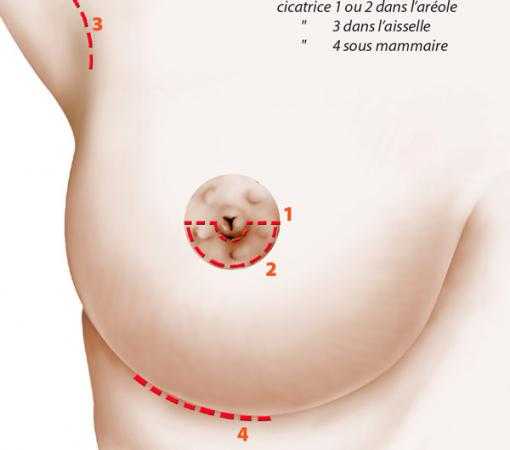
When the breasts show a certain degree of ptosis (sagging) or when the implant volume was significant, implant removal must be combined with breast reshaping to give them an attractive shape. This surgical step involves redraping the skin and removing excess skin to achieve a better result than what healing alone would allow after removal.
Breast implant removal is generally performed on an outpatient basis (leaving the clinic the same evening as the procedure).
The procedure is often performed under general anesthesia, but can also be performed under local anesthesia.
The procedure is not covered by health insurance, unless the initial procedure was covered.
Recovery after breast implant removal
Very limited pain
Postoperative pain is very limited. Breast implant removal involves less pain than implant placement, since the skin is not subject to the tension associated with the new breast contour created by the implant.
Recovery lasts a day or two. It is possible to return to work the day after the procedure. However, you should wait at least two to three weeks before resuming sports.
The result achieved
The result will depend on the patient's original anatomy, the quality of the skin, and the type of implant she had.
The final result of the procedure is not visible immediately after removal. While a change in volume can be observed immediately, the final shape of the breasts develops gradually over the weeks and months following the procedure, as the breast retracts to some degree to reach its final shape after a few months. The result of implant removal is generally considered final after 6 to 12 months.
Implant removal and breast lift
It should be noted that breast augmentation is a reversible procedure. When implants are removed, whether for aesthetic or medical reasons, the breasts will gradually return to their original shape if the augmentation was moderate and the breast tissue is still fairly "elastic".
If the volume of the removed implant was moderate, the breast will regain its original shape through tissue retraction. After a few months, the breasts will settle into their final shape and regain their original form. Sometimes, the breast tissue may have naturally decreased or increased slightly over time as well, and the result will then be of a different volume than before implant placement.
However, if the implant volume was significant or if the breasts showed a certain degree of sagging, removal must be combined with a breast lift to achieve the best possible result. The scars caused by this additional surgical step are those of a ptosis correction mastopexy.
In case of inflammation:
Breast implant removal is a minor procedure carrying very little risk, provided there is no associated complication. Indeed, removal is more complicated if the breast implant has caused tissue inflammation. In that case, the inflammatory "periprosthetic capsule" that isolates the foreign body from surrounding tissue must be at least partially removed.
Removing breast implants: in summary
- Result: Gradual, final after 6 to 12 months
- Anesthesia: General
- Hospitalization: Outpatient
- Pain: Very limited
- Scars: Discreet, position depends on the type of incision used
- Recovery: 1 to 2 days
- Return to sport: Gradual from 2-3 weeks
