
Excessive development of the breast area in men is a benign phenomenon that is often difficult to deal with emotionally. Whether related to the mammary gland (gynecomastia) or fat deposits (adipomastia), surgical treatments correct the appearance caused by what resembles "breasts" and excess breast volume in men.
1 - What is gynecomastia?
Gynecomastia refers to excessive development of mammary gland volume in men. This increase — also called mammary gland hyperplasia — can be unilateral or bilateral, symmetric or not.
Gynecomastia is characterized by a firm consistency on palpation. A mammary gland is always present in men, in the form of a simple breast bud. In the case of gynecomastia, the mammary gland is denser and concentrated around the areola.
Gynecomastia is generally idiopathic, meaning there is no direct cause for its appearance. However, it can be linked to abnormal hormone production or to medication use. In case of increased breast volume in a man, an assessment should be performed to identify the cause. If a cause is identified, a treatment specific to that cause may achieve a more or less significant reduction in mammary gland volume.
A plastic surgery procedure may be offered when no direct cause has been identified, or when the reduction observed following a specific treatment is not satisfactory to the patient.
Gynecomastia should be distinguished from adipomastia, even though the aesthetic consequences may initially seem similar. Adipomastia refers to a fat deposit located around the pectoral muscles. The presence of this fat can lead to the formation of what resembles "breasts". This phenomenon occurs in overweight men or, in particular, in men who have lost a significant amount of weight and whose skin has stretched. Liposuction is then the most effective technique for removing these localized fat deposits.
An increase in breast volume in men is often difficult to deal with emotionally. It challenges perceptions of the male body and the image one may have of masculinity. It can cause significant psychological discomfort and social withdrawal, especially if it first appears during adolescence.
2 - Treating gynecomastia and adipomastia in men
The surgical treatment of gynecomastia (or "gynecomastia correction") involves reducing breast volume through excision of the mammary gland. An incision is generally made at the lower part of the areola to perform a subcutaneous mastectomy.
In the case of adipomastia, the excess volume is removed by liposuction. When gynecomastia is combined with adipomastia (referred to as adipo-gynecomastia), both removal of the mammary gland and liposuction of the excess fat are performed.
In cases of isolated adipomastia, there is now an alternative to surgical treatment by liposuction. This is the equally radical and permanent medical treatment by cryolipolysis with Coolsculpting, which can also be performed at Dr. Kron's practice in Dual-System mode (meaning both "breasts" are treated at the same time), cutting the treatment time in half.
The second step of the procedure involves reducing the excess skin caused by the increased breast volume. The reduction in glandular volume generally allows for natural skin retraction, particularly in younger patients, who have firmer, more elastic skin.
When the excess skin is too significant, it can be surgically reduced during the procedure or during a second procedure, which necessarily results in a scar, located at least around the areola.
In some cases, gynecomastia may be partially covered by health insurance.
3 - Recovery after gynecomastia surgery
Surgical treatment of gynecomastia in men is a reliable, only mildly painful procedure, with generally simple recovery.
The duration of the procedure can vary depending on the type of procedure performed and the extent of the excess. The procedure is shorter in the case of simple liposuction. The procedure can last up to two hours when excision is combined with tissue surgery.
In all cases, with Dr. Kron, you benefit from an outpatient procedure under light general anesthesia with a laryngeal mask. This general anesthesia is assisted by local anesthesia, which prevents any pain from being felt.
In case of treatment by cryolipolysis, this is performed at the medical practice in about 1 hour 30 minutes in Dual-System mode.
After the procedure, pain is moderate. Simple painkillers can relieve it. Edema, bruising, and discomfort when raising the arms are common in the initial period. These gradually disappear after a few days.
It is advisable to suspend any sports activity for at least three weeks after the procedure. Sun exposure of the treated area should also be avoided in the months that follow.
Even though this is a safe, well-proven procedure, gynecomastia surgery remains a surgical procedure, which always carries residual risks that should be considered (see "Risks in cosmetic surgery").
Smoking increases the risk of surgical complications in any type of surgery. Stopping smoking 6-8 weeks before the procedure eliminates this additional risk. If you smoke, talk to your doctor, surgeon and anesthesiologist, or call a smoking cessation helpline to help reduce risks and give yourself the best chances.
4 - Before-after: treating male breasts
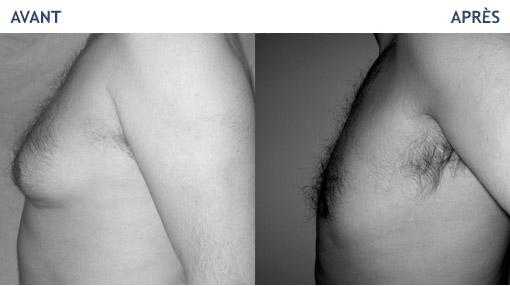
> See the before-after gallery dedicated to treating male breasts
