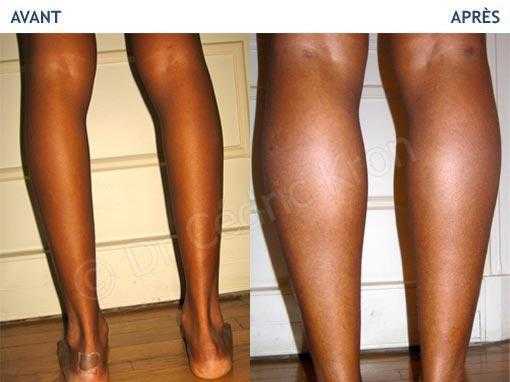
Calf lipofilling is a cosmetic surgery procedure that reinjects the patient's own fat into the calves to correct a lack of contour. It is a fat cell autograft that achieves a lasting enhancement of the calf's contour.
1. Principle of lipofilling
Lipofilling is a technique that re-injects autologous fat, meaning it uses the patient's own fat.
The surgeon begins by identifying the fat harvesting areas as well as the reinjection sites.
Then, fatty tissue is harvested through a micro-incision using a fine suction cannula. The fat cells are taken from a discreet area of the body where there is a reserve, or even an excess, of fat cells (generally the abdomen, knees, inner thighs, or "saddlebags").
The harvested fat then undergoes centrifugation for a few minutes to separate the cells to be grafted (intact fat cells) from the elements that should not be grafted (fat cells destroyed during harvesting, non-fat cells such as blood cells…).
The fat is reinjected using micro-cannulas allowing for incisions of about 1 mm.
The injections are performed in different planes and multiple directions so as to increase the contact surface between the grafted cells and the recipient (nourishing) tissues, allowing for good graft take.
The duration of the procedure can vary depending on the amount of fat to be injected and the number of areas treated. It generally ranges between 30 minutes and two hours.
2. Recovery after calf lipofilling
Depending on the patient and the procedure performed, simple local anesthesia or general anesthesia may be considered.
The procedure is generally performed on an outpatient basis.
Postoperative pain is very moderate in most cases.
It is normal for edema to appear within 48 hours after the procedure. This will fully resolve within 5 to 15 days following the procedure.
Bruising appears at the harvesting and reinjection sites. These bruises fade within 5 to 21 days.
Smoking increases the risk of surgical complications in any type of surgery. Stopping smoking 6-8 weeks before the procedure eliminates this additional risk. If you smoke, talk to your doctor, surgeon and anesthesiologist, or call a smoking cessation helpline to help reduce risks and give yourself the best chances.
3. Results of calf lipofilling
The result of calf lipofilling can be assessed once the edema and bruising have resolved. In the case of calf lipofilling, the edema takes longer to resolve. The result can be considered final after 3 to 6 months.
Lipofilling achieves a lasting result because it is a genuine autograft of the patient's own cells. The grafted fat cells remain alive for as long as the tissues in which they were grafted. Over time, there can be a loss of 10 to 30% of the reinjected fat volume. The surgeon takes this phenomenon into account when assessing the amount of fat cells to graft. Several lipofilling sessions may be needed to achieve the desired contour.
XBody sessions may be indicated to optimize and enhance the result of calf lipofilling. XBody is a muscle electro-stimulation device particularly effective for reshaping the body's muscles, slimming the legs, tapering the thighs and reducing cellulite.
4. Before-after: calf lipofilling
> See the before-after gallery dedicated to calf lipofilling